






The conversion of New York City’s historic office buildings into residential spaces—a centerpiece of Mayor Eric Adams’ vision for a post-pandemic urban core—has been thrown into uncertainty. Following a catastrophic structural failure at the former Pfizer headquarters at 235 E. 42nd St. in Midtown Manhattan, the New York City Department of Buildings (DOB) and the Department of Investigation (DOI) have launched a high-stakes, parallel inquiry into the project’s construction integrity.
As the building remains in a precarious state, investigators are focused on a startling allegation: that critical steel reinforcements, explicitly required by the project’s design, were never installed.
The July 7 Failure: A Project Halted
The incident occurred on July 7, when inspectors discovered two buckled, load-bearing steel columns and significantly sagging floors on the 21st level of the 235 E. 42nd St. property. The discovery effectively halted one of the most ambitious office-to-residential conversion projects in the United States.
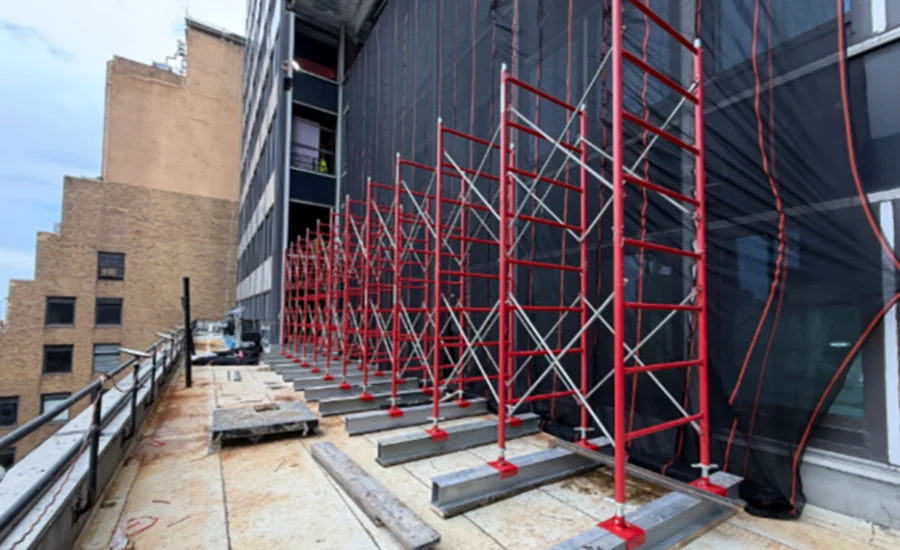
The structure, formerly the global headquarters for the pharmaceutical giant Pfizer, was in the process of a major vertical expansion. The buckling of the columns, which occurred beneath the footprint of this new addition, has raised immediate concerns regarding the structural stability of the entire tower. The DOB responded swiftly, ordering an immediate cessation of all work and mandating that the building’s owners secure the site to prevent further collapse.
Chronology of the Structural Investigation
The path to the current investigative impasse has been rapid and reactive.
- Early July: Construction crews continue work on the vertical expansion of the former Pfizer tower.
- July 7: During a routine inspection, engineers identify clear signs of structural distress: two columns on the 21st floor show visible buckling, and the floor deck above has begun to sag.
- July 8–10: The Department of Buildings arrives on-site, officially issuing a Stop Work Order. The building is cleared of non-essential personnel.
- Mid-July: The DOB begins a forensic audit of the site’s structural plans versus the as-built reality.
- July 16: Chris Behan, Principal Engineer at GACE Consulting Engineers, publicly asserts that the structural reinforcement mandated by GACE’s design for the 19th through 21st floors was absent during construction.
- Late July: The NYC Department of Investigation confirms it has joined the DOB in a parallel inquiry, signaling a move from a simple construction failure probe to a broader examination of professional negligence or regulatory oversight.
The Allegation: A Disconnect Between Design and Construction
At the heart of the controversy is a fundamental discrepancy between the blueprints and the structure. GACE Consulting Engineers, the firm of record for the project’s structural design, has gone on the record to state that the columns were not built according to specifications.
"The reinforcement from the 19th floor to the top of the 21st floor, which would have significantly increased the columns’ strength, was never installed," Chris Behan stated. "The structure was not reinforced as GACE’s design required."
A forensic review of city-approved drawings by various media outlets, including Gothamist, corroborates that the original steel columns beneath the vertical expansion were explicitly marked for reinforcement. In engineering terms, this reinforcement is not a suggestion; it is a critical component designed to distribute the immense weight of a vertical addition through the existing frame of an older building. The absence of this steel suggests that the columns were carrying a load they were never intended to support without the specified upgrades.
Oversight and Accountability: The Role of the Engineer of Record
The failure has ignited a broader industry debate regarding the duties of the "Engineer of Record" (EOR) during construction.
Christopher Raebel, vice president of engineering and research at the American Institute of Steel Construction, notes that while the industry typically separates the design phase from the "means and methods" of construction—which are left to the contractor—the EOR must remain an active participant.
"The engineer of record should always be involved," Raebel explained. "They should know what’s going on. Even if it’s during construction, they should at least be involved."
The fact that the missing reinforcement was not identified until a failure occurred suggests a potential breakdown in the communication chain between the steel erectors, the special inspection agencies, and the structural design firm. To address this, the DOB has ordered the project owners to retain Thornton Tomasetti, a preeminent third-party engineering firm, to oversee all stabilization efforts and conduct a comprehensive forensic review. Furthermore, the city has mandated that Special Testing & Consulting be brought on as an additional third-party inspection agency to provide a layer of scrutiny that supersedes the original project teams.
The Legal and Insurance Quagmire
As the technical investigation proceeds, a parallel battle is forming in the boardrooms and legal offices of the parties involved. In projects of this scale, when a failure of this magnitude occurs, the focus quickly shifts from safety to liability protection.
Robert Alfert, a board-certified construction attorney at Nelson Mullins, suggests that the atmosphere of cooperation seen in the immediate aftermath of the July 7 failure is likely to dissipate. "While most of the stakeholders will initially appear to be very collaborative, eventually everyone tends to back into their respective camps," Alfert noted. "The gravity, the risk and the liability exposures are so significant that it’s simply human nature: each party tends to look to its own self-interest and be very protective of itself."
The financial implications are staggering. Between the cost of emergency stabilization, potential demolition or remediation, legal fees, and the loss of revenue from construction delays, the damages could reach into the tens of millions of dollars. Insurance carriers are undoubtedly preparing to contest coverage based on whether the failure resulted from a design error, a construction oversight, or a failure in the inspection process.
Implications for NYC’s Conversion Trend
Perhaps the most significant fallout of the Pfizer incident is the "chilling effect" it may have on the city’s broader office-to-residential conversion agenda. City Hall has staked much of its economic recovery plan on the ability to transform millions of square feet of obsolete office space into housing.
If the 235 E. 42nd St. incident is found to be the result of systemic failures—such as inadequate inspection protocols or a lack of oversight on complex vertical expansions—the DOB may be forced to implement more stringent, and costly, requirements for all conversion projects. This could make the already difficult math of adaptive reuse even harder to justify for developers, potentially slowing the city’s progress in addressing its housing shortage.
Official Stance and Moving Forward
For now, the Department of Buildings remains measured in its public communication. While they have confirmed the involvement of the DOI, they have declined to comment on GACE’s specific claims regarding the missing steel.
"The investigation remains ongoing," a DOB spokesperson stated via email. "Civil enforcement actions are pending our findings."
The task for the teams currently working on the 21st floor is twofold: first, to safely support the building and ensure that the surrounding Midtown area is not at risk; and second, to preserve the evidence required to determine how such a critical oversight could pass through multiple levels of inspection.
For the residents of New York City and the construction industry at large, the Pfizer tower stands as a sobering reminder of the margins for error in high-rise construction. As investigators continue to sift through the steel and the records, the building—once a symbol of corporate might—has become a monument to the vital importance of structural integrity in the age of urban transformation.