




By: Editorial Staff
Based on Insights from: César Jiménez, CTO, Trans Americas Fiber
Latin America is currently navigating a pivotal moment in its digital evolution. While the region’s international bandwidth requirements are expanding at a rate that outpaces almost every other geographic market, the underlying physical infrastructure—the subsea cables that carry 99% of transoceanic data—is beginning to show its age. As the demands of Artificial Intelligence (AI), cloud computing, and high-definition content delivery intensify, the region faces a stark choice: continue to patch a legacy network designed for a voice-centric era or build a new, high-capacity foundation for the future.
César Jiménez, Chief Technology Officer at Trans Americas Fiber (TAFS), argues that while upgrading existing systems is a necessary component of regional strategy, it is no longer sufficient. With the launch of the TAM-1 cable system, the region is seeing the first signs of a "digital renaissance" that prioritizes route diversity, open access, and massive scalability.
I. Main Facts: The State of Latin American Subsea Infrastructure
The current landscape of Latin American connectivity is defined by a paradox of high demand and lagging investment. According to data from TeleGeography, international bandwidth usage in Latin America surged by approximately 25% in 2025, reaching a total of over 400 Terabits per second (Tbps). However, the infrastructure supporting this traffic is largely composed of "legacy" systems—cables laid two decades ago that were never intended to handle the data-heavy workloads of the 2020s.
The Rise of TAM-1
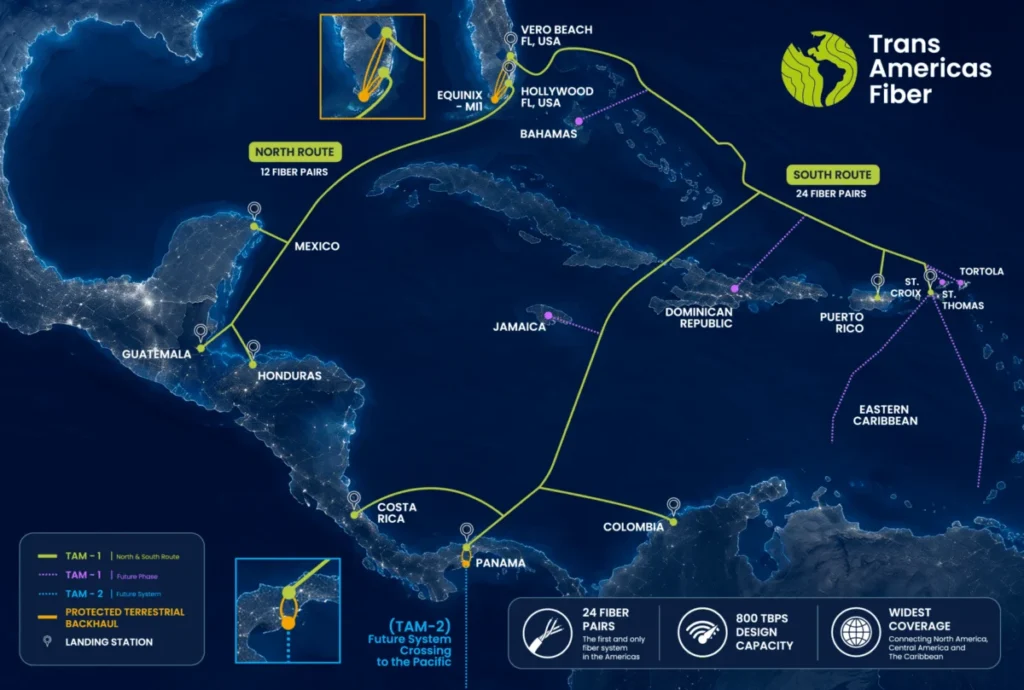
At the center of the region’s infrastructure overhaul is the TAM-1 cable system. This project represents several "firsts" for the Americas:
- High Fiber Count: It is one of fewer than five 24-fiber-pair subsea cable systems deployed globally and the first of its kind in the Americas.
- Massive Capacity: With a design capacity of 800 Tbps, TAM-1 offers more than 200 times the capacity of legacy Caribbean systems.
- Open Architecture: Unlike older "closed" systems, TAM-1 utilizes an open cable design, allowing customers to select their own terminal equipment and upgrade as transmission technology evolves.
A Shifting Investment Landscape
While global subsea investment is booming, Latin America has historically received a smaller slice of the pie. TeleGeography estimates that between 2023 and 2025, only USD 0.7 billion was invested in cables entering service in the region. Although this is expected to rise to USD 1.3 billion between 2026 and 2029, it remains significantly lower than the investment seen on Transatlantic or Transpacific routes.
II. Chronology: From Voice to AI – The Evolution of Traffic Patterns
To understand why the region requires new infrastructure, one must look at the historical trajectory of connectivity in Latin America.

1. The Legacy Era (Pre-2010)
In the early 2000s, subsea cables were primarily designed for voice traffic and basic internet browsing. These systems followed a "North-to-South" flow, connecting major Latin American hubs directly to the United States. The ownership model was dominated by traditional carriers—large telecommunications companies that operated "club cables" with restricted access.
2. The Content Provider Surge (2017–2022)
Around 2017, the hierarchy of subsea demand shifted. Content providers (hyperscalers like Google, Meta, and Amazon) began to play an active role in cable investment. Prior to this, their presence in Latin American subsea projects was non-existent. Today, more than 90 Tbps of demand on the US-to-Latin America route is driven by content providers, a segment growing at 50% annually.
3. The Modern Era: Cloud and AI (2023–Present)
The current era is defined by the "Cloud Footprint." While Latin America currently has fewer cloud availability zones than Europe or Asia, five more major zones are currently in the planning or construction phases. This infrastructure requires a different kind of connectivity—one that is dynamic, distributed, and capable of handling the low-latency requirements of AI processing and regional data centers.
III. Supporting Data: The Limits of Upgrading Legacy Systems
A common argument in the industry is that existing cables can simply be "upgraded" with new terminal equipment to meet demand. While this provides a short-term fix, the physics of older fiber optics presents an insurmountable ceiling.
The Physical Constraints of Aging Fiber
Many of the twenty-odd aging systems in the region have been in service for over 30 years. These cables were built using:
- Fewer Fiber Pairs: Older cables often have only 2 to 4 fiber pairs, compared to the 24 pairs found in TAM-1.
- Higher Attenuation: Older glass fibers lose signal strength (attenuation) more quickly than modern ultra-low-loss fiber.
- Smaller Effective Area: This limits the amount of light (and thus data) that can be pulsed through the fiber before distortion occurs.
Regional Growth Disparities
The need for new fiber is not uniform across the region, as some markets are "running hot." Supporting data highlights specific compound annual growth rates (CAGR) that underscore the urgency:
- Colombia: Leading the region with nearly 40% growth in bandwidth demand.
- Mexico: Growing at a 32% rate, driven by nearshoring and industrial digitalization.
- Brazil: Maintaining a steady 29% growth rate as the region’s largest digital economy.
In these markets, "spare capacity" on a legacy cable in a different country is of no use to an ISP or enterprise requiring local, high-speed throughput.

IV. Official Responses and Industry Perspective: The Trans Americas Fiber Strategy
César Jiménez and the leadership at TAFS emphasize that the future of the region depends on two pillars: Resilience and Access.
Engineering for Resilience
Latin America is uniquely vulnerable to natural disruptions, including hurricanes in the Caribbean and seismic activity along the Pacific coast. TAFS has addressed this by designing TAM-1 with a dual-route architecture:
- The North and South Systems: These two diverse subsea routes allow for seamless re-routing. If a hurricane disrupts the North System, traffic can be shifted to the South System via switchable branching units.
- Future-Proofing: TAFS has already installed "stubbed" branching units during the initial construction phase. This allows for the planned TAM-2 Pacific extension to be integrated without "disruptive marine work" on the existing live system.
The Open Access Mandate
Historically, smaller carriers and Internet Service Providers (ISPs) in Latin America were at a disadvantage, often forced to buy capacity from competitors who owned the subsea infrastructure. TAFS is pivoting toward a "neutrality" model.
"For decades, the best connectivity was available mainly to those who owned the infrastructure," Jiménez notes. "Modern systems are tending towards neutrality and open access."
This shift is evidenced by the "Anchor Tenants" who have already committed to TAM-1. These include a mix of traditional giants and regional players:
- AT&T and Millicom
- AXTEL (Mexico)
- Grupo ICE (Costa Rica)
The partnership with Grupo ICE is particularly transformative; it is projected to increase Costa Rica’s total international capacity by more than twentyfold, effectively overnight.
V. Implications: What This Means for the Region’s Future
The deployment of high-capacity systems like TAM-1 carries profound implications for the socio-economic development of Latin America.

1. Enabling the AI Economy
AI requires massive datasets to be moved between data centers for training and inference. Without the 800 Tbps capacity offered by modern systems, Latin American enterprises would be forced to rely on "long-haul" processing in North American data centers, resulting in latencies that render real-time AI applications unviable.
2. Digital Sovereignty and Competition
By providing open access to dark fiber and managed optical services, TAFS is lowering the barrier to entry for smaller ISPs. This increased competition is expected to lower the cost of high-speed internet for the end consumer, bridging the "digital divide" that has historically hampered rural and underserved communities in the region.
3. Economic Resilience
Redundant subsea routes are not just a technical luxury; they are an economic necessity. In a world where banking, governance, and trade are entirely digital, a single cable cut caused by a ship’s anchor or an earthquake can paralyze a national economy. The route diversity built into the TAM-1 and TAM-2 projects provides a "safety net" that ensures the region stays online regardless of external shocks.
4. A Model for Emerging Markets
The "Both, and More" approach advocated by Jiménez—upgrading where possible but building new where necessary—serves as a blueprint for other emerging regions. It acknowledges that while legacy assets have value, they cannot be the sole engine for future growth.
Conclusion
As the submarine cable industry prepares to gather at events like Submarine Networks EMEA in 2026, the focus will undoubtedly be on how regions like Latin America are closing the gap with the rest of the world. Through the leadership of figures like César Jiménez and the deployment of massive-scale projects like TAM-1, Latin America is no longer just a consumer of global data; it is becoming a high-speed hub in its own right. The transition from 30-year-old "voice" cables to 24-fiber-pair "AI" systems marks the beginning of a new era for the region’s digital economy—one defined by scale, diversity, and open access.