DUBLIN, Ireland — In a milestone that marks a transformative shift for South American digital sovereignty, EllaLink has officially announced the successful placement of two high-tech branching units on the Atlantic seabed. These units, dedicated to the Brazilian states of Pará and Maranhão, represent the "invisible foundation" of a massive infrastructure project designed to bring high-speed, low-latency fiber-optic connectivity to the heart of the Amazon basin.
The announcement, made on September 16, 2026, confirms that the Lum@link marine installation campaign is proceeding on schedule. With these branching units now resting at depths exceeding 3,600 meters, the states of Pará and Maranhão are no longer mere spectators to the global digital revolution; they are now physically integrated into the EllaLink system—the first high-capacity submarine cable to directly link Latin America and Europe.
1. Main Facts: The Physical Foundation of a Digital Future
The deployment of the branching units (BUs) is a technical feat of precision engineering. Manufactured and installed by Alcatel Submarine Networks (ASN), these devices were lowered to the ocean floor at staggering depths: 3,920 meters for the Pará branch and 3,690 meters for the Maranhão branch.
Key Specifications of the Installation:
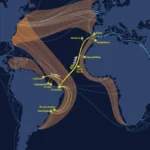
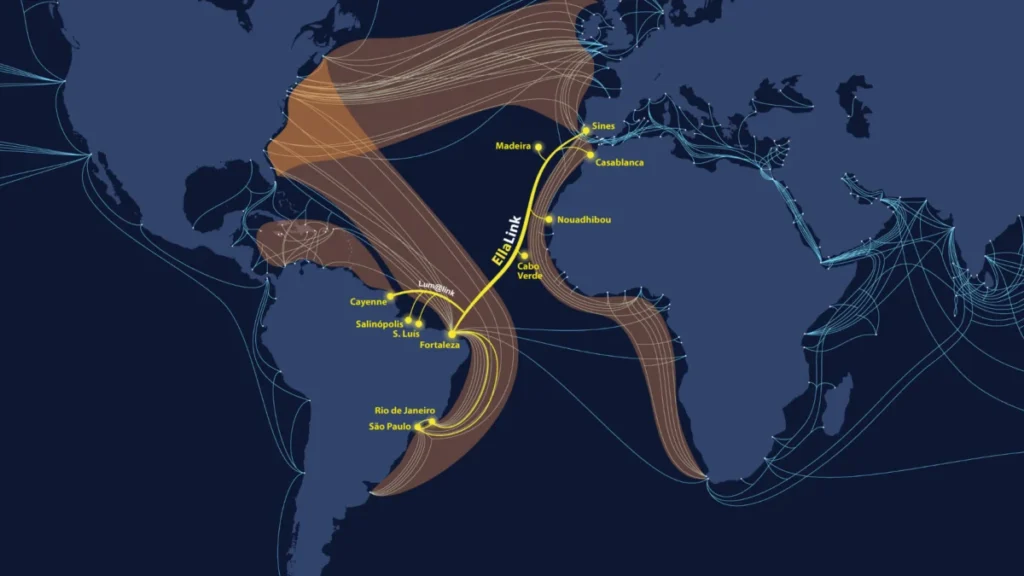
Primary System: EllaLink (Connecting Sines, Portugal, to Fortaleza, Brazil).
Extension System: Lum@link (Connecting Cayenne, French Guiana, to the EllaLink trunk).
New Landing Points: Salinópolis (Pará) and São Luís (Maranhão).
Initial Capacity: A combined 17 Terabits per second (Tbps), with significant scalability for future demand.
Partnerships: PRODEPA (Pará), ATI (Maranhão), SPLANG (French Guiana), and the European Union.
A branching unit is essentially a "Y-junction" for the digital age. By installing these units during the current Lum@link campaign, EllaLink has ensured that when the final cables are laid to the shores of Salinópolis and São Luís, they can be "plugged in" without disrupting the data flow of the main international trunk. This strategic foresight transforms a point-to-point connection into a scalable, multi-state network.
2. Chronology: From Calais to the Brazilian Seabed
The journey to this month’s successful deployment began years ago in the design offices of Dublin and Paris, but the physical campaign reached its zenith over the summer of 2026.
June 2026: The "Mais Conectado" project was officially showcased during the 2nd EU-Brazil Investment Forum. This presentation solidified the financial and political backing of the European Union’s Global Gateway strategy and the Team Europe initiative.
July 2026: The cable ship CS Île d’Yeu, a specialized vessel operated by Alcatel Submarine Networks, departed from the manufacturing facility in Calais, France. The ship was laden with approximately 2,100 kilometers of fiber-optic cable and the necessary repeaters and branching units for the Lum@link extension.
August 2026: The vessel reached the waters off French Guiana and Northern Brazil, beginning the delicate process of "plowing" the cable into the seabed and deploying the branching units at precise GPS coordinates.
September 16, 2026: EllaLink confirms that the BUs for Pará and Maranhão are securely in place. Simultaneously, the company announced the completion of the Cable Route Study (CRS). This study is a critical precursor to the final "landing" of the cables, as it maps the safest and most efficient path through offshore currents and coastal terrain.
Expected Late 2026: The Lum@link system is on track to enter full commercial service, providing a direct optical connection between Cayenne, Fortaleza, and Sines.
3. Supporting Data: Financing and Technical Infrastructure
The scale of the project is matched by the complexity of its funding. This is not merely a private venture but a multi-national public-private partnership aimed at bridging the "digital divide" in South America.
The Financial Ecosystem
The branching units were funded directly by the state governments of Pará and Maranhão, but the broader "Mais Conectado" (More Connected) program relies on a sophisticated web of international grants and loans:
European Union: Provided a €29.9 million grant via the Connecting Europe Facility (CEF) Digital program.
IDB Group & AFD Group: The Inter-American Development Bank and the Agence Française de Développement provided co-financing to ensure the project reached the most isolated regions of the Amazon.
SPLANG: The public company for digital development in French Guiana acted as a primary developer for the Lum@link extension.
Beyond Bandwidth: SMART Sensors
One of the most innovative aspects of this installation is the integration of SMART (Science Monitoring And Reliable Telecommunications) sensors. With the support of the European Union, these sensors are capable of:
Seismic Monitoring: Detecting underwater tectonic movements to provide early warnings for tsunamis or earthquakes.
Climate Data Collection: Measuring deep-sea temperatures and pressures to assist in global climate change research.
Scientific Monitoring: Turning a commercial data pipe into a permanent laboratory for marine biology and oceanography.
4. Official Responses: A Vision for Regional Modernization
The leadership involved in the project views the deployment not just as a hardware success, but as a socio-economic catalyst.
Carlos Brandão, Governor of the State of Maranhão, emphasized the long-term strategic value:
"Maranhão is preparing today to take a leading role in the digital economy of the future. We are investing in high-speed connectivity, fiber optic infrastructure, cybersecurity, and digital inclusion. This is a project that modernizes the state, strengthens our economy, and creates the conditions to attract investment. We want a Maranhão where technology helps reduce inequality and improve the lives of our people."
Philippe Dumont, CEO of EllaLink Group, highlighted the technical foresight of the company’s "step-by-step" expansion strategy:
"Laying these two branching units is one of those milestones that is invisible from the shore but decisive for everything that follows. They are the physical foundation… The design of the branches is well advanced; the cable route study is finalized, so the marine survey can start as soon as Pará and Maranhão states have finalized their funding. Since its inception, the EllaLink system has been designed to welcome new markets step by step."
The partnership with state agencies—PRODEPA in Pará and ATI in Maranhão—ensures that the states maintain ownership and commercial control over the capacity. Unlike traditional models where a single telecom giant controls the "pipe," the EllaLink model allows the states to manage their own digital destiny.
5. Implications: Redefining the Amazon’s Digital Geography
The impact of this project on Northern Brazil cannot be overstated. Historically, Pará and Maranhão have been "digitally stranded," relying on long, vulnerable terrestrial backhaul routes that stretch thousands of kilometers across the rainforest to reach international gateways in the south of Brazil.
I. Resilience and Redundancy
Terrestrial cables in the Amazon are prone to accidental cuts during road construction, flooding, and environmental degradation. By establishing a direct subsea landing point in Salinópolis and São Luís, the states gain a "redundant" route. If the terrestrial path fails, the subsea link ensures that hospitals, schools, and government services remain online.
II. Economic Transformation
Low latency—the speed at which data travels—is the currency of the modern economy. By connecting directly to Europe and the existing Fortaleza hub, Pará and Maranhão become attractive destinations for:
Data Centers: Which require high-speed cooling and massive, reliable data pipes.
E-Commerce & Fintech: Reducing the "lag" for financial transactions.
Business Process Outsourcing (BPO): Allowing local talent to work for global firms from their home states.
III. Social Inclusion and "E-Government"
The "Mais Conectado" program specifically targets isolated communities. The high-capacity backbone will allow for the expansion of 5G networks into the interior of the Amazon. In practical terms, this means:
Telemedicine: Specialized doctors in Belém or São Luís can assist rural clinics via high-definition video.
Distance Education: Providing university-level resources to students in remote riverine communities.
Public Safety: Enhanced communication for environmental protection agencies monitoring the rainforest.
IV. Geopolitical Significance
The involvement of the EU Global Gateway and the EU-LAC Digital Alliance highlights a shift in global infrastructure competition. By funding these projects, Europe is positioning itself as the preferred digital partner for Latin America, offering an alternative to other global powers. This "Team Europe" approach emphasizes environmental standards, data privacy, and local ownership—factors that are increasingly important to the Brazilian government.
Conclusion: The Horizon for 2027 and Beyond
As the CS Île d’Yeu continues its work and the Lum@link system prepares for its 2026 launch, the focus now shifts to the "last mile" of the subsea journey. With the branching units in place, the technical risk of the project has been significantly mitigated.
The successful deployment of these units is a testament to what can be achieved when regional governments, international financiers, and private innovators align their goals. For the people of Pará and Maranhão, the Atlantic Ocean is no longer just a geographical boundary—it is now their fastest highway to the rest of the world.