


By Barry Elliott, Director, Capitoline Ltd
The rapid ascendancy of Artificial Intelligence and High-Performance Computing (AI HPC) has fundamentally altered the physical landscape of the modern data center. We are witnessing a transition that industry observers aptly describe as moving from “servers in racks” to “data centers in cabinets.” As power-hungry GPU clusters—exemplified by NVIDIA’s GB200/300 NVL72 architectures—become the new standard, the traditional infrastructure models that have sustained the digital economy for two decades are being pushed to their breaking point.
The industry now faces a critical tension: how to maintain the rigorous resilience standards set by the ANSI/TIA-942 framework while accommodating the extreme, dense, and monolithic requirements of modern AI super-pods.
Main Facts: The End of the Air-Cooled Era
For the past twenty years, the data center industry has operated within a comfort zone of air-cooled racks, typically supporting power densities of 5 kW to 15 kW per rack. These installations were designed for modularity, maintenance, and high availability. However, the AI HPC model requires an unprecedented leap in density.
Today, GPU-centric clusters routinely demand 132 kW per rack, with industry roadmaps already pointing toward 1 MW per rack. This shift is not merely quantitative; it is qualitative. These clusters behave more like a single, giant, indivisible computer than a collection of individual servers.
Key Technical Challenges:
- Power Distribution: Moving from standard AC distribution to 48V DC, and eventually 800V DC, to mitigate I²R (resistive) losses.
- Cooling Dynamics: The abandonment of air-cooling in favor of Direct Liquid Cooling (DLC), where water is delivered directly to the chip.
- Cabling Complexity: The shift toward ultra-short, direct-attached cables (InfiniBand/Ultra-Ethernet) where a single cluster can contain over 130,000 individual links, effectively eliminating the possibility of traditional structured patch-panel management.
Chronology: From General Purpose to Accelerated Computing
- The Early 2000s (The Era of Modular Air Cooling): Data centers were built around standard 19-inch racks. The primary goal was efficient airflow management and "N+1" redundancy. The ANSI/TIA-942 standard became the bedrock for these designs, ensuring that power and cooling could be maintained without disrupting IT operations.
- 2015–2020 (The Rise of Hyperscale): As cloud providers expanded, the focus shifted to massive scale. However, even at scale, individual rack power requirements remained relatively stable, and the standard TIA-942 cabling models remained largely sufficient.
- 2023–Present (The AI HPC Explosion): The arrival of Large Language Model (LLM) training requirements forced a move toward high-density GPU clusters. The infrastructure moved from "general purpose" to "accelerated compute." This created an immediate conflict with existing facility design standards, as the physical requirements for power and cooling exceeded the physical space and safety margins of traditional raised-floor, air-cooled environments.
Supporting Data: Infrastructure under Duress
The current ANSI/TIA-942 model relies on the ability to isolate equipment for maintenance while keeping the rest of the system online. In the AI HPC world, this concept is challenged by the nature of the "Super-Pod."
Power Infrastructure
In current GPU clusters, compute units receive power via a 48V DC bus. To move beyond the 132 kW-per-rack limit, 800V DC distribution is the proposed solution. By increasing voltage, engineers can decrease current, thereby reducing heat loss and the size of the necessary copper conductors. However, implementing this at scale involves significant cost and the need for new, robust safety protocols that differ significantly from standard AC-based UPS designs.
Cooling Infrastructure
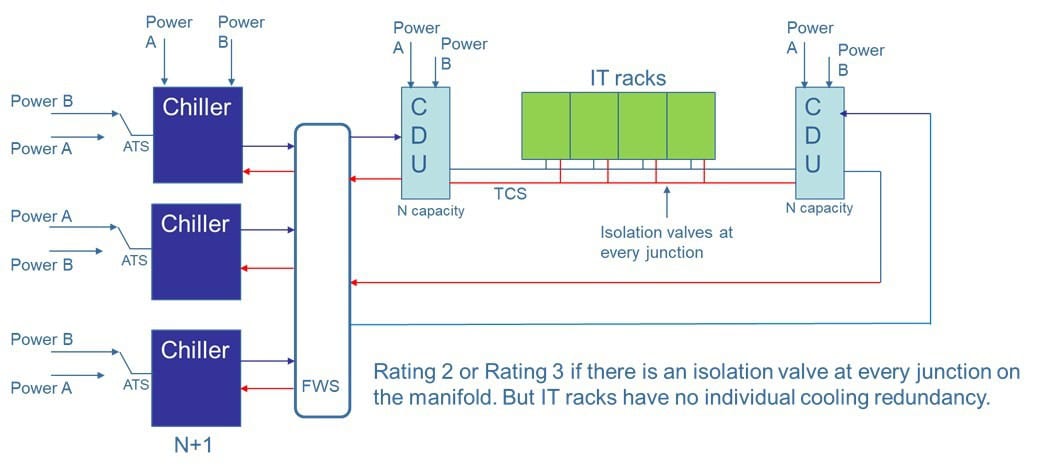
Direct Liquid Cooling (DLC) is now essential. Unlike air-cooled systems, where fans are redundant and can be replaced, liquid manifolds are often single points of failure. In many current designs, there is only one water feed pipe entering and exiting a compute unit. If this pipe or the rack manifold fails, the entire cluster loses cooling. Furthermore, the reliance on high-purity water—requiring filter changes as frequently as every 42 days—introduces a requirement for "planned downtime" that directly contradicts the high-availability expectations of Tier 3 and Tier 4 data centers.
Implications: A Mismatch of Standards and Reality
The industry is currently in a state of architectural drift. The ANSI/TIA-942 standard is a masterpiece of resilience and redundancy, but it was not designed to govern a 1 MW "single-computer" rack that requires near-constant cooling and zero physical patch-panel intervention.
The Redundancy Paradox
If we attempt to apply traditional redundancy to AI super-pods, the cost becomes prohibitive. Doubling the cooling infrastructure or the power buses for a 1 MW rack requires a massive capital expenditure. Moreover, because the AI cluster acts as a single logical entity, "concurrent maintainability" is no longer a matter of simply unplugging a faulty server; the entire rack or pod must often be treated as a unified system.
The Cabling Crisis
Traditional structured cabling, which allows any device to connect to any other, is physically impossible in the super-pod environment. The necessity of using ultra-short (3–7 meter) cables to ensure signal integrity for InfiniBand technology means that we have traded physical flexibility for raw performance. Redundancy, in this context, must shift from the physical layer to the logical, software-defined layer.
Official Responses and Path Forward
As a member of the TIA Data Center Program Workgroup, our perspective is clear: we cannot simply ignore the ANSI/TIA-942 standard, nor can we force 20-year-old design philosophies onto 21st-century AI hardware.
Proposing a New Architecture
We recommend a hybrid approach:
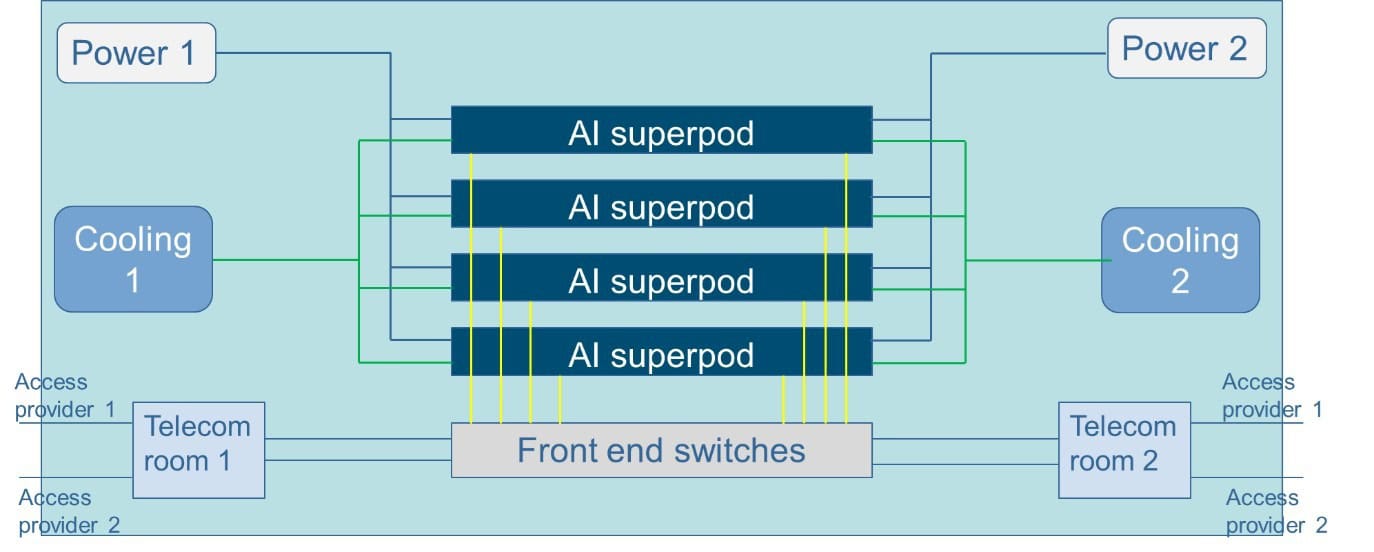
- The "Single Computer" Concept: Treat the AI rack as a self-contained unit. Its internal cabling, power, and cooling are part of its proprietary design.
- Facility-Level Compliance: Apply ANSI/TIA-942 at the point of interface. The building must provide redundant 800V feeds, redundant facility-level water loops, and redundant telecommunications pathways that connect to the pod.
- Standardization: We are currently working with the TIA TR-42 committee to develop new addenda to the TIA-942 standard. These will provide guidelines for AI HPC environments, ensuring that operators can certify their facilities for resilience even when the internal workings of the compute-pods are "black boxes."
The Need for Collaboration
The data center ecosystem—comprising cooling experts, power engineers, cabling specialists, and IT architects—must collaborate. The goal is to define what "Rating 3" and "Rating 4" mean in an environment where the infrastructure is no longer a collection of discrete parts, but an integrated, high-density machine.
The future of AI is dependent on the stability of these super-pods. Without a standardized approach to infrastructure, we risk a bifurcation in the market: those who build for performance at the cost of reliability, and those who build for reliability at the cost of performance. Through the TIA-942 framework, we can achieve both.
Conclusion: Bridging the Gap
The AI HPC revolution is not merely a change in processor speed; it is an infrastructure overhaul. As we continue to refine these systems, the data center industry must ensure that "High Performance" does not come at the expense of the "High Availability" that the digital world demands. By evolving our standards to embrace the realities of high-density cooling and power, we will ensure that the next generation of computing is as resilient as it is powerful.
For those interested in navigating these changes, participating in the TIA TR-42 committee or pursuing TIA-942 certification remains the most effective way to stay ahead of the curve. The infrastructure of tomorrow is being written today—let us ensure it is built on a foundation of professional, tested, and reliable engineering.
Resources and Further Reading:
- For professional certification in data center design and ANSI/TIA-942 compliance, visit Capitoline Training.
- For information on the ANSI/TIA-942 standard, visit TIA Online.
- To participate in the ongoing evolution of these standards, contact the TIA TR-42 Committee.
Note: The views expressed in this article are those of the author and do not necessarily reflect the official position of the TIA or its member companies.