








In the rapidly evolving landscape of modern telecommunications, the backbone of connectivity remains fiber optic technology. For system integrators, network architects, and IT managers, the fundamental design decision often begins with a single, critical question: Should I deploy single mode or multimode fiber?
While the choice may seem trivial to the uninitiated, it is a foundational decision that dictates the lifespan, bandwidth capacity, and total cost of ownership (TCO) for any network infrastructure project. As high-definition video distribution, cloud computing, and advanced security protocols become standard requirements, understanding the nuance of these two transmission media is no longer optional—it is a professional necessity.
Main Facts: Decoding the Physics of Light Transmission
At its core, fiber optic cabling is a marvel of physics, using light pulses to transmit data across long distances at speeds unattainable by traditional copper cabling. The primary distinction between single mode (SMF) and multimode (MMF) fiber lies in how they guide that light.
The Physics of the Core
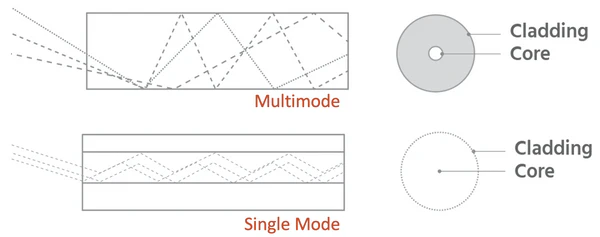
Single mode fiber is engineered with a microscopic optical core—typically around 9µm in diameter. This narrow path forces light to travel in a single, direct beam, effectively eliminating the distortion known as "modal dispersion." Because the light travels in one mode, it maintains signal integrity over vast distances.
Conversely, multimode fiber features a significantly larger core, commonly 50µm in modern iterations (with older, legacy systems still utilizing 62.5µm). This larger "pipe" allows multiple light modes to propagate simultaneously. While this makes the light easier to couple into the cable, it introduces modal dispersion, where different light rays arrive at the receiver at slightly different times, limiting the distance and data rate.

Attenuation and Signal Stability
Because single mode fiber allows only one path for light, there is far less reflection and signal loss (attenuation). This makes it the undisputed champion for long-haul transmission. Multimode fiber, while sufficient for short-reach campus or data center environments, suffers from higher attenuation due to the multiple paths light must navigate, resulting in a signal that degrades much faster than that of its single mode counterpart.
A Chronological Perspective: The Evolution of Fiber Standards
To understand where we are today, we must look at the evolution of fiber standards.
- The Early Era (1970s–1980s): Fiber was a specialized technology used primarily by telecommunications giants for long-distance carrier networks. During this era, single mode was the gold standard for high-capacity, long-distance inter-city links.
- The Multimode Expansion (1990s): As local area networks (LANs) began to emerge in office environments, the need for cost-effective, easy-to-terminate fiber grew. Multimode fiber became the industry darling because the large core size made it easier to align with the cheaper, less precise LED light sources available at the time.
- The Modern Convergence (2010s–Present): With the explosion of 10G, 40G, and 100G networking, the industry has seen a massive shift. While multimode remains relevant for short-distance "patching" in data centers (using OM3, OM4, and OM5 grades), single mode has become the default for nearly everything else, including building-to-building links and high-bandwidth security and AV systems.
Supporting Data: Performance Metrics at a Glance
When choosing between these media, data-driven decisions are paramount. The following breakdown compares the operational realities of these cables.
Bandwidth Capacity
- Single Mode: Offers virtually unlimited bandwidth. The physical limitation is not the cable itself, but the speed of the transceivers at either end. This makes it "future-proof" for 100G, 400G, and beyond.
- Multimode: Bandwidth is limited by the distance and the grade of the glass. The industry classifies multimode into five grades (OM1 through OM5), with each grade offering higher modal bandwidth than the last. However, even the most advanced multimode fiber cannot compete with the long-term scalability of single mode.
Transmission Distance
- Single Mode: Capable of spanning tens of kilometers without the need for signal regeneration. For most commercial, industrial, and residential projects, single mode is "overkill" in the best way possible—it ensures the link will never be the bottleneck.
- Multimode: Generally restricted to a "short-reach" envelope. Depending on the data rate, multimode is typically effective at distances ranging from 300 meters to 550 meters. Beyond this, signal degradation becomes a critical issue, requiring expensive signal repeaters or switches.
Economic Realities: The "Hidden" Cost
Perhaps the most surprising fact in the fiber industry is that single mode cable is generally 30% cheaper to manufacture than multimode fiber. This is due to the simplicity of the manufacturing process for a smaller core.
However, integrators must look at the total system cost. While the cable is cheaper, single mode electronics—such as SFP transceivers and lasers—are more precise and traditionally carry a higher price tag. Multimode electronics, which utilize cheaper VCSEL (Vertical-Cavity Surface-Emitting Laser) technology, are more affordable. The decision rests on the scale of the project: for short runs, multimode might save on electronics; for large projects, the lower cost of single mode cabling often offsets the higher price of the transceivers.

Official Perspectives: Industry Best Practices
Industry experts at NSI Industries and other infrastructure leaders emphasize that the "old way" of thinking—relying solely on multimode for local links—is rapidly disappearing.
"The industry is moving toward a single mode-first architecture," says one senior infrastructure consultant. "When an integrator runs a cable, they want it to stay in the walls for 20 years. Single mode is the only medium that guarantees that longevity. The cost gap for transceivers is closing rapidly, making the choice for single mode a logical, future-proof business decision."
However, official guidance warns against "passive mixing." Because the core sizes are fundamentally different (9µm vs. 50µm), a single mode fiber connected to a multimode fiber will experience massive return loss and signal failure. If a site requires both, the only professional solution is the use of active media converters or SFP-based switches that can translate the signal between the two protocols.
Implications for Future-Proofing Installations
The decision to install fiber is a significant labor investment. Labor costs for pulling cable are often much higher than the material costs themselves. Therefore, the long-term implications of your choice are critical.
1. Future-Proofing
If you install multimode fiber today, you are capping the potential data speeds for that cable’s entire lifespan. If you upgrade your network equipment in five years, you may find that the cable you installed yesterday is no longer sufficient. Single mode provides a "future-proof" foundation, as the glass is capable of carrying virtually any data rate that future transceivers will support.
2. Versatility
Single mode fiber is incredibly versatile. It is used for enterprise networking, high-resolution 8K video distribution, security camera backbones, and even broadcast-grade audio. By standardizing on single mode, an integrator can simplify their inventory, carrying fewer cable types and fewer connector variations, which reduces overhead and potential for errors on the job site.
3. The "Gotcha" Factor
Integrators should remain vigilant regarding connectors. While tools and testers are often compatible with both, the connectors themselves—SC, LC, ST—must be matched to the specific cable type. Using an LC connector designed for multimode on a single mode cable can lead to misalignment and catastrophic signal loss. Always ensure that the fiber grade is clearly marked at both ends of every pull.
Conclusion
Choosing between single mode and multimode fiber is a balance of physics, budget, and long-term strategy. While multimode fiber served as the backbone of the early networking age, single mode fiber has emerged as the clear winner for modern, high-performance installations.
For the vast majority of building pre-wires, network upgrades, and AV distribution projects, single mode is the recommended choice. It offers lower material costs, superior bandwidth, and significantly longer transmission distances. While the initial investment in high-quality single mode transceivers may be slightly higher, the return on investment through performance, reliability, and future-readiness is undeniable.
As you plan your next installation, remember that your fiber backbone is the nervous system of the building. Investing in the right technology today ensures that your infrastructure will not just meet today’s demands, but will be ready for the innovations of tomorrow.

For further assistance with your specific network architecture or to learn more about our fiber connectivity solutions, please visit the NSI Network Infrastructure Support Portal. Our team of experts is ready to help you navigate the complexities of your next high-performance installation.