





The global telecommunications landscape is standing on the precipice of its most significant transformation since the transition from voice-centric analog systems to data-centric digital networks. As artificial intelligence evolves from a centralized cloud-based tool into a decentralized, mobile-first ecosystem of autonomous "agents," the underlying infrastructure of the world’s wireless networks is being forced to adapt.
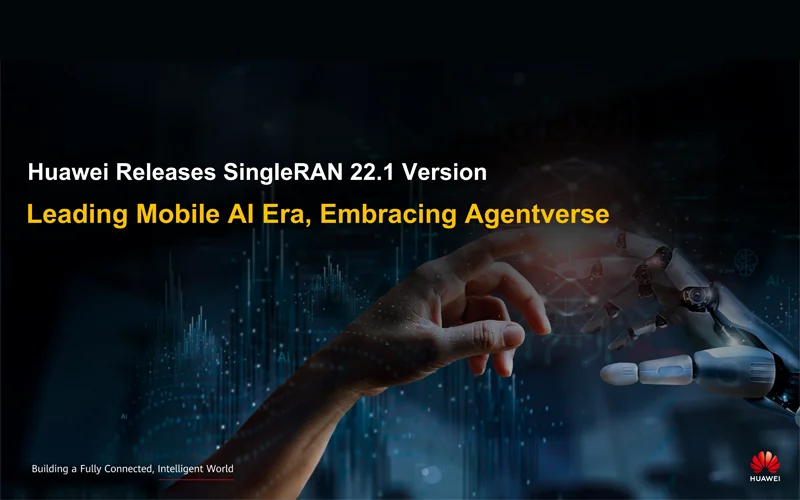
In response to this shift, Huawei has launched its SingleRAN 22.1 software, a commercial release specifically engineered to support what the industry is calling the "Mobile AI" era. This update represents more than a simple patch or an incremental speed boost; it is a systematic reconstruction of radio access network (RAN) logic, designed to accommodate the "Agentverse"—an interconnected web of billions of AI agents that require constant, low-latency, and high-uplink connectivity.
Main Facts: A New Foundation for Mobile Intelligence
Huawei’s SingleRAN 22.1 is the first commercial wireless software suite built specifically to handle the unique traffic patterns of AI agents. Unlike traditional mobile users who primarily consume content (downlink-heavy), AI agents are "prosumers" of data, constantly capturing environmental information, processing it through multimodal models, and collaborating with other agents in real-time.
The core of the SingleRAN 22.1 release focuses on six technical pillars designed to resolve the bottlenecks of legacy 4G and 5G architectures. These include massive enhancements in uplink capacity, the transition to deterministic low latency, and the introduction of "Intelligent Resource Orchestration."
Key highlights of the release include:
- Widespread Adoption: Despite being a new release, SingleRAN 22.1 has already been commercially deployed at 35 operator sites across 23 countries, signaling a high level of market readiness and urgency among global carriers.
- Hardware Synergy: The software is optimized for Huawei’s next-generation UBBPi series baseband boards, creating a hardware-software synergy that maximizes processing power for AI-driven tasks.
- Shift in Network Philosophy: The software moves away from "best-effort" connectivity—the standard for the last decade—toward guaranteed service levels (SLAs) that are critical for autonomous systems.
Chronology: From Human-Centric to Agent-Centric Connectivity
The journey toward SingleRAN 22.1 is rooted in the rapid acceleration of AI adoption over the last 24 months.
The Pre-AI Era (2019–2022): 5G rollouts focused primarily on "Enhanced Mobile Broadband" (eMBB). The goal was simple: faster downloads for high-definition video and smoother browsing. Networks were designed with a 10:1 ratio, favoring downlink over uplink.
The Generative AI Breakthrough (2023): The rise of Large Language Models (LLMs) changed the nature of mobile interaction. Users began interacting with AI on their devices, but the processing remained largely in the cloud. However, it became clear that the next step would be "Agentic AI"—software that doesn’t just answer questions but performs tasks autonomously.
The Shanghai Launch (2024): Earlier this year, at a major industry forum in Shanghai, Huawei officially unveiled SingleRAN 22.1. The launch was a direct response to the "Mobile AI" roadmap, which envisions AI moving from the data center to the edge of the network.
The Current Deployment Phase: As of late 2024, the software is transitioning from pilot programs to mass deployment. Huawei expects over 100 operators globally to have integrated the software by the end of the year, marking one of the fastest adoption rates for a RAN software update in the company’s history.
Supporting Data: Quantifying the Agentverse
To understand why a software overhaul like SingleRAN 22.1 is necessary, one must look at the staggering projections for AI agent proliferation. The data suggests that the volume of non-human "users" will soon dwarf the human population.
The Population Explosion of AI Agents
According to data from IDC, the world will see more than 1 billion actively deployed AI agents by 2029. This number is expected to more than double to 2.2 billion by 2030. However, Huawei’s own "Intelligent World 2035" report offers an even more aggressive forecast, predicting that 900 billion AI agents will be active globally by 2035. Crucially, the report suggests that 90% of these agents will operate in mobile scenarios—embedded in drones, autonomous vehicles, industrial robots, and wearable devices.
The "100 Agents per Human" Vision
This bullish outlook is shared by silicon giants. NVIDIA CEO Jensen Huang recently articulated a vision of the future workforce where every human employee is supported by a "personal digital workforce" of over 100 AI agents. These agents will handle everything from scheduling and data analysis to real-time translation and creative collaboration.
The Traffic Paradigm Shift
Legacy networks were built for "asymmetric" traffic. A user might send a small request (uplink) and receive a large 4K video stream (downlink). AI agents invert this logic. An autonomous drone or a mobile AI assistant using "computer vision" needs to stream high-definition video up to the cloud or edge for processing. This requires:
- Massive Uplink: A projected 10x increase in required uplink capacity compared to 5G standards.
- Deterministic Latency: For an AI agent to collaborate with another agent (e.g., two autonomous cars negotiating an intersection), latency must be guaranteed at sub-20 milliseconds, not just "averaged" at that level.
Technical Deep Dive: The Six Pillars of SingleRAN 22.1
Huawei’s SingleRAN 22.1 addresses these demands through six specific technical advancements that reconstruct the network’s multi-dimensional capabilities.
1. Multimodal Uplink Optimization
SingleRAN 22.1 introduces algorithms that prioritize uplink traffic for AI-heavy applications. By utilizing multi-band coordination, the software allows devices to aggregate uplink carriers, ensuring that the "eyes" of AI agents—their cameras and sensors—can feed data into the network without bottlenecking.
2. Deterministic Low Latency (DLL)
In a traditional "best-effort" network, latency can spike during periods of high congestion. SingleRAN 22.1 uses intelligent scheduling to provide a "fast lane" for AI agent coordination. This ensures that the time-sensitive "reasoning" of an AI agent is not delayed by a nearby user downloading a movie.
3. Intelligent Resource Orchestration
Using native AI within the RAN itself, the software can predict traffic patterns in real-time. If a fleet of AI-powered delivery robots enters a specific cell sector, the network automatically reallocates resources to maintain their connectivity, shifting power and bandwidth dynamically.
4. Hardware-Software Synergy with UBBPi
The software is the first to fully unlock the potential of the UBBPi series baseband boards. These boards provide the massive computational "horsepower" required to run the complex signal-processing algorithms that define 5G-Advanced (5G-A). This synergy allows for higher spectral efficiency and lower power consumption per bit.
5. Multi-Agent Collaboration Framework
The software includes protocols specifically designed for agent-to-agent communication. This reduces the "overhead" of data transmission, allowing agents to "talk" to each other with minimal metadata, preserving battery life for mobile devices and reducing overall network load.
6. Green Intelligence
Recognizing the massive energy demands of AI, SingleRAN 22.1 incorporates "0-bit, 0-watt" technology. This allows network components to enter a deep sleep mode during micro-seconds of inactivity, waking up instantly when an AI agent initiates a data transfer. This ensures that the expansion of the Agentverse does not lead to an unsustainable increase in carbon emissions.
Official Responses: A Paradigm Shift for the Industry
The leadership at Huawei views SingleRAN 22.1 not as an evolution, but as a total reconstruction of what a mobile network is supposed to be.
He Yunru, Vice President of Huawei Wireless Network Solutions, emphasized the scale of this transition during the Shanghai launch. “Mobile AI is not a service upgrade — it is a paradigm shift for the industry,” He stated. “As the first commercial version for the Mobile AI era, SingleRAN 22.1 comprehensively reconstructs network capabilities, empowering operators to seize new opportunities in the Token economy, making intelligence omnipotent, omnipresent, and perpetual.”
The mention of the "Token economy" is particularly significant. In the world of AI, "tokens" are the basic units of text or data processed by models. By aligning network capabilities with the "Token economy," Huawei is signaling that future mobile contracts may not just be about "Gigabytes of data," but about the "number of AI tokens" a network can reliably process and transmit.
Industry analysts have noted that this move puts significant pressure on competitors. By deploying SingleRAN 22.1 in 23 countries already, Huawei is effectively setting the global standard for 5G-Advanced and Mobile AI infrastructure, forcing other vendors to accelerate their own "AI-native" software roadmaps.
Implications: The Road to 2030 and Beyond
The implications of Huawei’s SingleRAN 22.1 extend far beyond the technical specifications of a wireless update. It marks the beginning of a new era in telecommunications.
The Rise of the "Proactive" Network
For decades, networks have been reactive—responding to a user’s click. In the Mobile AI era enabled by SingleRAN 22.1, networks will become proactive. With native AI, the RAN will anticipate the needs of autonomous systems, allocating resources before a bottleneck even occurs.
Economic Impact: The Token Economy
As He Yunru suggested, the business model for mobile operators is set to change. Operators who successfully deploy SingleRAN 22.1 will be able to offer tiered services based on "Intelligence SLAs." An industrial manufacturer might pay for a "High-Reliability Agent Tier" to ensure their factory robots never lose their AI connection, creating a new and lucrative revenue stream for telcos that have long struggled with the "commoditization" of data.
Bridging the Gap to 6G
While 6G is still a decade away, SingleRAN 22.1 serves as the bridge. Many of the concepts being built into this software—such as the integration of sensing and communication, and the use of AI to manage the radio layer—are the foundational building blocks of what will eventually become 6G.
Conclusion
The "Agentverse" is no longer a futuristic concept; it is an imminent reality that requires a fundamental rethink of global infrastructure. With the release and rapid deployment of SingleRAN 22.1, Huawei has made its opening move in the Mobile AI era. By solving the foundational bottlenecks of uplink capacity and deterministic latency, the company is providing the "connectivity oxygen" required for billions of AI agents to live, work, and collaborate in a mobile environment. For operators, the choice is becoming clear: adapt to the agent-centric future or risk obsolescence in an increasingly intelligent world.