

By Barry Elliott, Director, Capitoline Ltd
The data center industry is currently witnessing a tectonic shift in architecture, driven by the explosive rise of Artificial Intelligence (AI) High-Performance Computing (HPC) models. Systems like the NVIDIA GB200/300 NVL72 are not merely incremental upgrades to existing server technology; they represent a fundamental departure from traditional "servers in racks" to a new reality of "data centers in cabinets." As these massive compute clusters demand power and cooling densities previously relegated to the realm of theoretical engineering, the industry’s established standards for resilience—most notably the ANSI/TIA-942 model—face an urgent need for evolution.
The Main Facts: The New Compute Landscape
For two decades, the global data center footprint has been defined by standardized air-cooled racks, typically operating within a power and cooling capacity of 5 to 15 kW per rack. These facilities were designed to satisfy the ANSI/TIA-942 Rating 3 or 4 requirements, emphasizing concurrent maintainability and fault tolerance.
However, the advent of GPU-dense "superpods" has rendered these legacy benchmarks insufficient. We are now seeing racks that demand 132 kW, with future roadmaps targeting 1 MW per cabinet. This is not just a change in scale; it is a change in nature. These GPU clusters behave less like independent servers and more like a single, massive, monolithic computer. This transition forces a confrontation between the rigid physical requirements of AI hardware and the long-standing industry protocols for uptime and redundancy.
Chronology: From Air-Cooled Reliability to Liquid-Cooled Intensity
The evolution of the modern data center can be mapped through three distinct eras:
- The Legacy Era (2000–2020): Characterized by air-cooled, low-density racks. Infrastructure was built around the principle of flexibility, where any server could be swapped or reconfigured without disrupting the rack’s cooling or power distribution.
- The Immersion Experiment (2020–2023): As chip densities rose, the industry began experimenting with immersion cooling. While effective, it remained a niche solution for specific HPC workloads, failing to gain widespread adoption due to operational complexity and maintenance hurdles.
- The GPU Superpod Era (2024–Present): The introduction of massive GPU interconnects and high-bandwidth memory (HBM) has necessitated Direct Liquid Cooling (DLC). Here, the cooling infrastructure is no longer a peripheral support system; it is an integrated, non-redundant component of the compute silicon itself.
Supporting Data: The Physics of Power and Cooling
To understand the infrastructure crisis, one must look at the specific physical constraints of the new AI hardware.
The Power Challenge
In traditional data centers, power distribution was straightforward. In the AI world, however, compute units rely on 48V DC power. To achieve 132 kW, the industry uses a three-phase UPS system feeding an AC distribution bus, which then converts to DC via power supply units (PSUs) within the rack.
NVIDIA and other hardware manufacturers are already looking beyond this to 800V DC distribution systems. The move to higher voltage is a necessity born of physics: at 1 MW per rack, the current required at lower voltages would necessitate copper busbars of impractical proportions. By moving to 800V, engineers reduce the current, thereby minimizing I²R (resistive) losses. Yet, this introduces massive costs, as the entire power distribution path must be redesigned to support this higher voltage, challenging the economic viability of traditional redundancy.
The Cooling Paradox
At 132 kW, air cooling is obsolete. Even immersion cooling faces thermal limits. The industry has converged on Direct Liquid Cooling (DLC), where water is delivered directly to the chip.
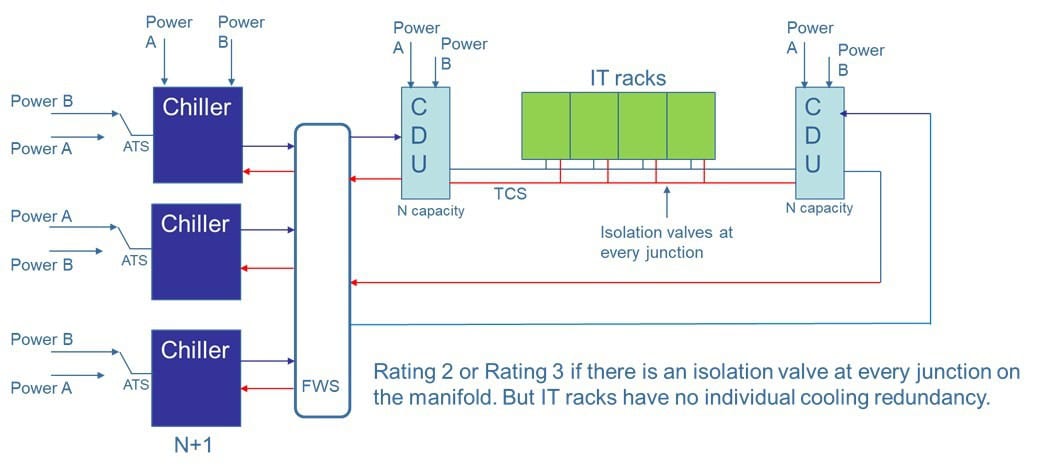
The structural problem is one of "single points of failure." In these GPU compute units, there is often only one inlet and one outlet pipe. These connect to a rack-level manifold, which connects to a pod-level manifold, and eventually to a Cooling Distribution Unit (CDU). Because the water is forced through micro-channels within the chips, water purity is a life-or-death requirement for the hardware. Some manufacturers recommend filter changes every 1,000 hours. In the context of a TIA-942 Rating 4 data center—which mandates no planned downtime—this maintenance requirement is fundamentally incompatible with the existing operational philosophy.
The Breakdown of Traditional Cabling
Perhaps the most dramatic departure from tradition is found in the physical layer. The TIA-942 standard encourages structured cabling, where patch panels in every rack allow any device to connect to any other.
In a GPU supercluster, this model completely collapses. We are now dealing with "front-end" and "scale-out" networks that rely on ultra-short (3–7 meter) direct-attached cables utilizing InfiniBand or Ultra-Ethernet. A single twelve-rack model can house upwards of 131,000 cable links. In this environment, conventional patch panels are physically impossible to accommodate. Redundancy here has shifted from the physical layer to the logical layer, where networking protocols dynamically reroute traffic around failing nodes.
Implications for Industry Standards
The central challenge is that the AI HPC "superpod" refuses to conform to the TIA-942 definition of a "rack." If we continue to treat these pods as collections of individual racks, we will consistently fail to achieve the required levels of resilience.
A New Architecture Proposal
We propose that the industry must bifurcate its infrastructure strategy:
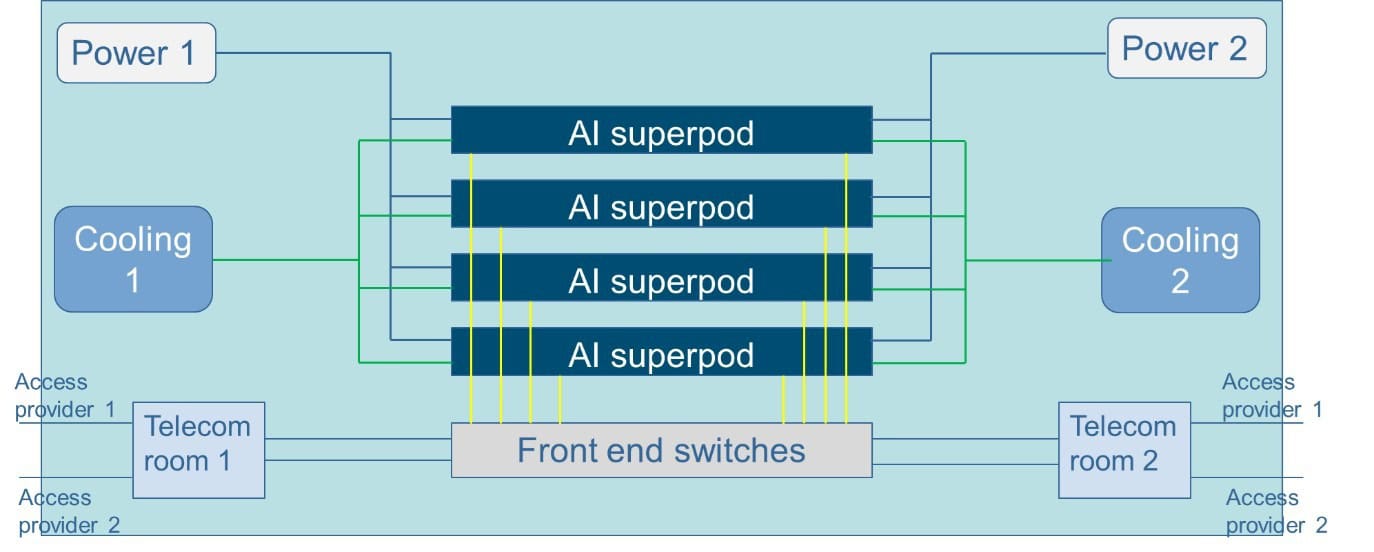
- The Pod as a Single Computer: The compute pod should be viewed as a single, monolithic machine. Its internal power distribution, liquid cooling, and intra-pod cabling should be treated as integrated components of that computer.
- The Facility as the Resilience Layer: The ANSI/TIA-942 Rating requirements should be applied to the support infrastructure surrounding the pod. This means providing dual, redundant telecommunications paths, dual power feeds from separate UPS systems, and redundant facility water supplies (FWS) that interface with the pod’s CDU.
By decoupling the internal, non-redundant nature of the GPU pod from the external, highly-redundant nature of the building infrastructure, we can restore the TIA-942’s goal of high availability.
Conclusion: The Path Forward
The data center sector is currently in a "Wild West" phase regarding AI infrastructure. Implementations are often rushed, prioritizing compute density over the long-term operational resilience that the ANSI/TIA-942 standard was designed to guarantee.
This is not a failure of the standard, but rather a reflection of its current scope. The TIA TR-42 committee, which oversees the ANSI/TIA-942 standard, is the logical venue to address these gaps. We must work to incorporate specific architectures that account for the unique, high-density, liquid-cooled, and high-cable-count nature of AI HPC environments.
For data center operators, the choice is clear: either adapt the standards to reflect the realities of modern AI hardware, or risk operating facilities that, while powerful, lack the resilience required for the backbone of the global digital economy. As we move forward, the collaboration between hardware manufacturers, facility engineers, and standards bodies like the TIA will be the defining factor in whether the next generation of data centers can successfully balance the voracious demands of AI with the unwavering necessity of uptime.
Resources for Continued Professional Development
To navigate these changes, industry professionals are encouraged to engage with the following resources:
- Capitoline Training: For those seeking certification in TIA-942 design and facility management, visit www.capitolinetraining.com.
- TIA-942 Standards: Access the full documentation via the official TIA Online portal.
- Committee Participation: To influence the evolution of these standards, join the TIA TR-42 Committee.
This blog was developed by a member of the TIA Data Center Program Workgroup. The views expressed herein are those of the author and do not necessarily reflect the official position of the TIA or its member companies.