





The rapid ascendancy of Artificial Intelligence (AI) is fundamentally altering the architectural requirements of modern IT networks. As organizations rush to integrate advanced technologies—ranging from intelligent IoT ecosystems to high-speed edge inference platforms—the underlying network infrastructure faces unprecedented strain. These applications demand higher bandwidth, consistent power delivery, and rigorous scalability. However, a significant barrier remains: the massive footprint of legacy coaxial infrastructure embedded in security, transportation, and industrial facilities.
For many enterprises, the choice seems binary: undertake a disruptive, multi-million dollar "rip-and-replace" project to install modern fiber/copper cabling, or fall behind in the AI race. Enter Ethernet and Power over Coax (EPoC) technology—a bridge between the past and the future. By utilizing the XC60-084-91-770 managed RX switch from Versa Technology, organizations can now repurpose existing coaxial foundations to support the high-performance demands of modern AI-driven surveillance and edge computing.
Main Facts: The EPoC Paradigm Shift
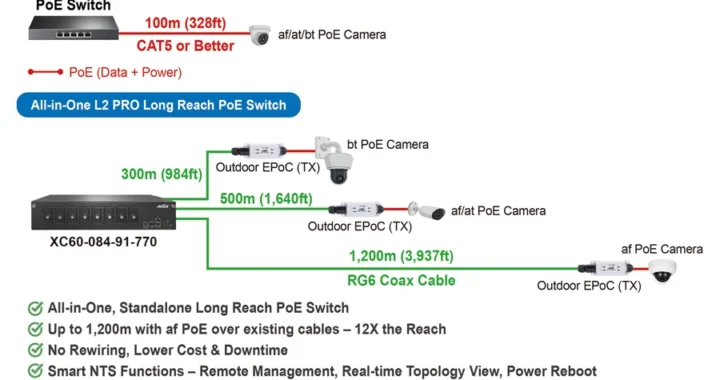
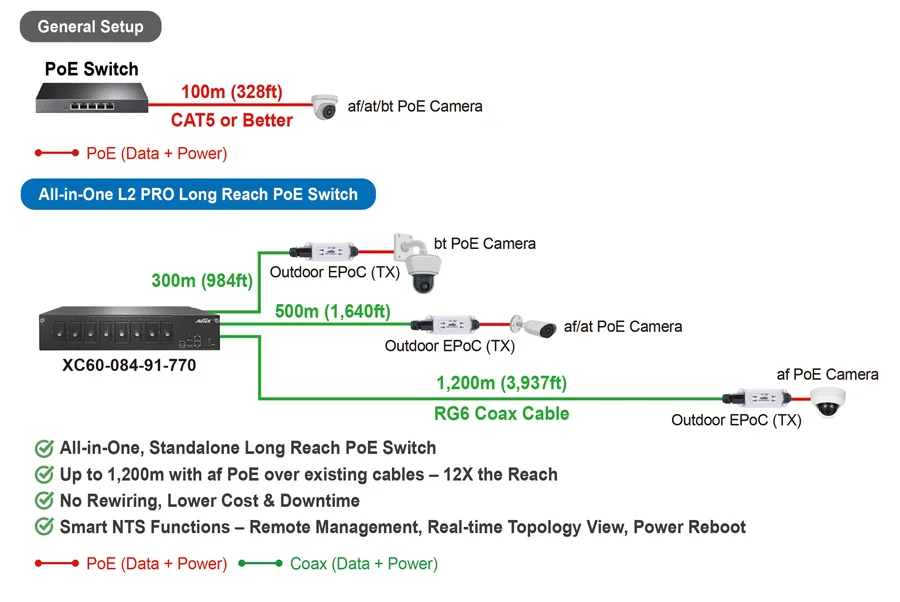
EPoC (Ethernet and Power over Coax) is a sophisticated transmission technology that delivers high-speed digital Ethernet data and low-voltage DC power over existing 75-ohm coaxial cabling (such as RG59 or RG6). This capability effectively bypasses the traditional 100-meter distance limitation inherent to standard Ethernet.
The Versa Technology XC60-084-91-770 managed switch serves as the central hub for this transition. Key specifications include:

- Extended Reach: Capable of transmitting data up to 1,200 meters (approx. 3,937 feet) without signal degradation.
- High-Density Power: Provides up to 90W of PoE (Power over Ethernet) per port, with a total budget of 720W.
- Flexible Topology: Supports daisy-chain, peer-to-peer, and ring network configurations.
- Intelligent Management: Features an advanced Network Topology System (NTS) that includes auto-discovery, cable diagnostics, and real-time power monitoring.
Chronology of Infrastructure Evolution
The transition from legacy analog systems to modern AI-ready networks can be categorized into four distinct phases:
- The Analog Era (1980s–2010s): Organizations deployed vast networks of coaxial cabling to support basic closed-circuit television (CCTV) and analog sensors. This infrastructure was robust but limited in bandwidth.
- The IP Transition (2010s–2020): As IP cameras became the standard, the "rip-and-replace" model became common. Organizations struggled with the massive capital expenditure of removing miles of coax to install Category cabling.
- The Edge AI Emergence (2020–Present): With the rise of edge computing, cameras and sensors are no longer just passive capture devices; they are localized AI inference engines requiring consistent, high-bandwidth connections and significant power.
- The EPoC Integration (Current): Modern solutions like the XC60-084-91-770 allow for a "hybrid-modernization" approach. Instead of a complete overhaul, legacy cables are re-tasked to carry modern, AI-grade IP signals, effectively extending the lifespan of original capital investments by decades.
Supporting Data: Why Infrastructure Matters for AI
AI workloads are not merely "data-heavy"; they are "latency-sensitive." When a camera performs real-time facial recognition or object tracking at the edge, even a millisecond of packet loss can lead to false positives or total system failure.
The Power-Distance Conundrum
Standard Ethernet (Cat5e/6) begins to suffer from attenuation after 100 meters, requiring mid-span power injectors or costly localized switching. In large-scale industrial plants or transit hubs, this necessitates building new telecommunication closets every 300 feet.
Conversely, EPoC technology leverages the superior shielding and thick copper core of coaxial cable to maintain signal integrity over distances 12 times greater than standard Ethernet. Furthermore, the 90W PoE budget per port ensures that advanced AI edge devices—which often include heaters, motorized PTZ components, and high-intensity infrared lights—receive consistent, flicker-free power.

Cost-Benefit Analysis
Installing new cabling in a facility involves more than the cost of the wire. It involves structural engineering, permits, labor, and downtime—often the most expensive components of a project. By choosing an EPoC-managed switch, organizations avoid:
- Structural Demolition: No need to drill through concrete or open ceilings.
- Operational Downtime: Existing surveillance can remain active while new IP nodes are brought online sequentially.
- Disposal Costs: Avoiding the removal and recycling of legacy cabling lowers the project’s environmental impact.
Official Perspective: The Versa Technology Approach
Versa Technology has positioned its XC60-084-91-770 switch as a cornerstone for what they define as "AI-Ready Infrastructure." Their development philosophy focuses on the reality that for most enterprise environments, a full infrastructure overhaul is not a viable strategy.
"The shift to AI is being driven by a fundamental physical shift in where data is processed," notes a spokesperson from Versa. "Organizations are deploying more AI-powered cameras, sensors, and edge computing platforms, but the network must evolve accordingly. Our EPoC solutions are designed to ensure that the infrastructure is no longer the bottleneck. By providing intelligent management tools—such as graphical floor maps and auto-discovery via ONVIF—we allow IT departments to treat their old coaxial network as a modern, manageable, and intelligent IP backbone."
Implications: The Future of the Intelligent Edge
The implications of EPoC-enabled AI networking are profound, particularly for sectors that have been traditionally "slow-to-digitize."

1. Enhanced Security and Public Safety
In large venues like stadiums or airports, the ability to deploy AI-enabled cameras at extreme distances allows for deeper, more sophisticated monitoring of perimeter zones without sacrificing image quality or processing speed.
2. Industrial Automation and Smart Manufacturing
In factories, AI sensors monitoring machine health often require deep, shielded cabling to operate in environments with high electromagnetic interference (EMI). Coaxial cable is naturally resistant to such interference, making EPoC a more stable choice for industrial AI than standard unshielded twisted pair (UTP) cabling.
3. Sustainability and ESG Goals
Sustainability is now a top-tier business priority. By reusing existing infrastructure, companies significantly reduce their "carbon footprint" associated with construction and manufacturing of new copper cabling. Moreover, the XC60-084-91-770’s ability to allocate power dynamically ensures that energy is not wasted on inactive nodes, contributing to more efficient, greener data centers.
Implementation Best Practices
For organizations looking to deploy EPoC, a systematic approach is recommended:

- Physical Audit: Before deployment, conduct a sweep of the existing coaxial runs. Ensure that the cabling is of a quality standard (e.g., RG59/RG6) and that connectors are securely terminated.
- Phased Migration: Use the switch’s ability to run legacy and modern IP devices simultaneously to transition one area at a time. This minimizes risk and allows for testing of localized AI models.
- Leverage Management Tools: Use the integrated NTS to map the physical layout of the building. By monitoring live traffic trends, IT managers can identify "bottleneck zones" and adjust bandwidth allocation before latency issues arise.
- Security Patching: Treat the EPoC switch as a critical network node. Regularly update firmware to ensure that the AI-edge devices remain protected against emerging cybersecurity threats.
Conclusion: Future-Proofing Through Innovation
The transition to an AI-driven future does not have to be an expensive, chaotic, or risky endeavor. By choosing the right technological bridge, organizations can transform their aging coaxial infrastructure into a high-performance engine for innovation.
The XC60-084-91-770 EPoC managed switch is more than just a piece of hardware; it is a strategic asset that preserves capital, accelerates deployment, and guarantees the power and reach required by the next generation of intelligent edge applications. As the digital and physical worlds continue to merge through AI, Versa Technology remains committed to helping organizations modernize their networks without the heavy burden of total infrastructure replacement.
For those ready to move forward, the first step is a simple audit of the cabling already hidden within your walls. The future of your network is already there—it just needs the right connection to wake it up.
To learn more about how EPoC technology can be tailored to your specific organizational needs, or to request a demonstration of the XC60-084-91-770, contact the experts at Versa Technology today.