





[City, State] – [Date] – In a pivotal moment for enterprise AI adoption, Palo Alto Networks today announced the general availability of Prisma AIRS AI Gateway. This groundbreaking solution is positioned as the definitive AI control plane for organizations grappling with the inherent tension between the accelerating pace of AI integration and the critical need for robust security and governance. The launch, a testament to the company’s swift integration of innovations from its recent Portkey acquisition, promises to empower businesses to scale AI initiatives at machine speed without compromising on enterprise-grade security and control.
The digital landscape is undergoing a profound transformation, shifting from software-defined operations to an AI-orchestrated future. This paradigm shift presents a fundamental challenge: how to harness the immense potential of artificial intelligence while maintaining essential oversight and security. Palo Alto Networks contends that a unified architecture, centered around a dedicated AI Gateway, is not merely beneficial but foundational to navigating this new era.
"Every modern enterprise is moving from an organization run by software to one orchestrated by AI, creating a tension between velocity and control," stated [Name and Title of a Palo Alto Networks Executive, e.g., Rishard Khan, Chief Product Officer at Palo Alto Networks]. "To resolve this tension, organizations require a unified architecture. Today, we are announcing the general availability of the Prisma AIRS AI Gateway, the AI control plane for the enterprise. Driven by the absolute conviction that an AI Gateway is foundational to the modern AI infrastructure stack, we are bringing AI innovations from the Portkey acquisition to Prisma AIRS just six weeks after closing. You can now scale AI at machine speed without compromising on enterprise-grade security and control."
The Unprecedented Surge in AI Footprint: Outpacing Traditional Controls
The adoption of AI within enterprises is no longer a nascent trend; it’s an explosion. Telemetry data from Palo Alto Networks’ next-generation firewalls paints a stark picture of this rapid expansion. In late last year, Machine Communication Protocol (MCP) activity, a key indicator of AI-driven interactions, stood at a modest 11%. By mid-2026, this figure has surged to an astonishing 41.4%.
This dramatic increase in AI engagement is mirrored by a twelve-fold growth in monthly AI transaction volume over the same six-month period. More alarmingly, some individual AI sessions have been observed transferring hundreds of megabytes of sensitive enterprise data outbound. This data suggests that the "AI footprint" an organization can effectively govern today is likely the smallest it will ever be, highlighting the urgent need for proactive control mechanisms.
The most aggressive AI adoption is currently concentrated in areas such as coding assistants, enterprise agents, and sophisticated copilots. As these AI tools interact with backend systems and process information, enterprise data inevitably flows outwards with each request. This dynamic creates a security and governance challenge of unprecedented scale and speed, demanding immediate attention from IT and security leaders.
The Breaking Point: When Every Team Embraces AI
The rapid proliferation of AI tools across different departments and teams within an organization often outpaces the existing security and governance infrastructure designed to manage them. This disconnect leads to a cascade of potential vulnerabilities and operational inefficiencies:
- Shadow AI Proliferation: Development teams, eager to leverage AI for productivity gains, often adopt unsanctioned AI models and services without proper vetting or integration into corporate security frameworks. This creates "shadow AI" environments that are invisible to IT and security teams, posing significant risks.
- Data Leakage and Compliance Violations: When AI agents interact with sensitive data, the risk of unintentional data exfiltration or non-compliance with regulations like GDPR or CCPA escalates dramatically. The sheer volume and velocity of AI-driven data movement make manual oversight impossible.
- Inconsistent Security Policies: Without a centralized control plane, enforcing consistent security policies across diverse AI applications and models becomes an insurmountable task. This leads to a patchwork of security measures, leaving critical gaps.
- Cost Overruns and Unmanaged Spend: The consumption of AI models and services can lead to substantial and often unbudgeted costs. Without clear visibility into usage patterns and associated expenses, enterprises risk significant financial overruns.
- Prompt Injection and Model Manipulation: Sophisticated AI models are susceptible to malicious inputs, such as prompt injection attacks, which can be used to extract sensitive information or manipulate AI behavior.
Faced with these escalating challenges, many organizations find themselves at an impasse. The common responses – either completely blocking AI traffic, a move that stifles innovation, or adopting a permissive stance with the promise of implementing controls later, a strategy fraught with peril – are fundamentally flawed. Both approaches bypass the critical step of actively observing and controlling AI actions in real-time.
Accelerating AI Adoption Through Unified Control
To truly scale AI adoption safely and effectively, enterprises require a single, authoritative control plane positioned between every AI interaction and the underlying backend models. This is precisely the role Prisma AIRS AI Gateway is designed to fulfill. By consolidating AI governance, identity management, and runtime controls into a unified platform, the AI Gateway empowers organizations to:
- Gain Comprehensive Visibility: Understand who is using what AI tools, for what purpose, and how much it is costing.
- Enforce Granular Policies: Define and enforce rules around approved AI models, tools, and access permissions without disrupting developer workflows.
- Protect Sensitive Data: Prevent the leakage of proprietary code, credentials, and customer data by AI applications.
- Manage Costs Effectively: Track AI spending by team or project, enabling FinOps initiatives and proactive budget enforcement.
- Ensure Secure Agent Identity: Establish trust by binding verifiable identities to AI agents, ensuring only authenticated and authorized agents can interact with backend systems.
- Implement Real-time Threat Prevention: Detect and neutralize threats like prompt injection attacks and prevent the exfiltration of sensitive information.
How the Prisma AIRS AI Gateway Operates: A Unified Enforcement Point
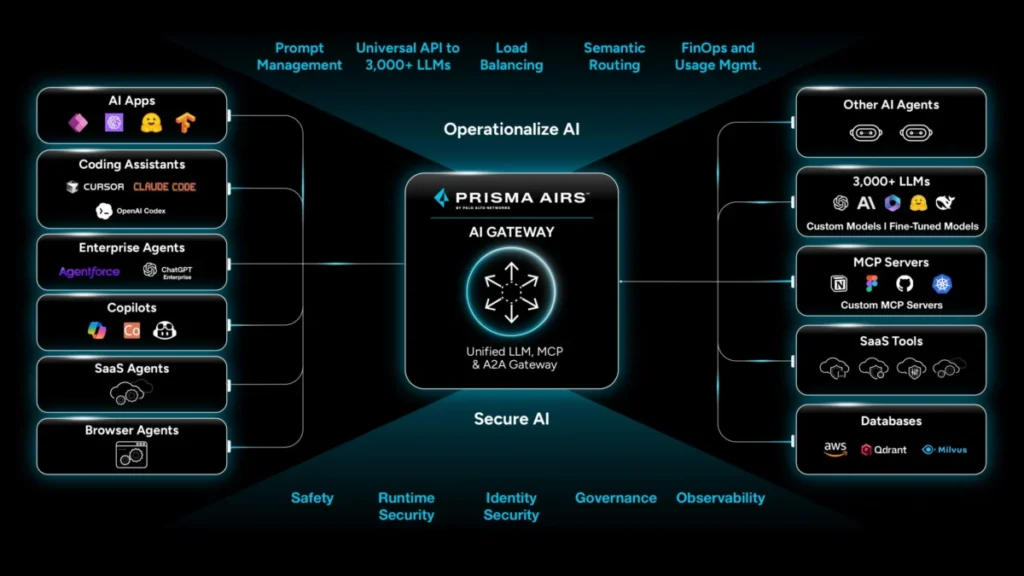
The Prisma AIRS AI Gateway operates as an inline intermediary for all AI interactions. It sits between end-users, AI applications, and the backend Large Language Models (LLMs) and other AI services. This strategic placement allows it to function as a unified gateway for LLMs, Machine Communication Protocols (MCPs), and Agent-to-Agent (A2A) communications, providing a single enforcement point for all operational and security controls.
This architecture ensures that development teams can continue to utilize their preferred coding assistants, enterprise agents, and copilots without interruption. Crucially, the enforcement of security and governance policies shifts to the infrastructure layer, where platform teams can maintain centralized ownership and oversight.
The capabilities delivered through this unified control plane are comprehensive and designed to address the multifaceted challenges of AI integration:
1. Unrivaled Observability:
Every AI request is mapped to a single, unified view, providing real-time insights into usage patterns, individual users, projects, token counts, latency, and associated costs. This granular visibility allows organizations to immediately identify and retire "shadow AI" infrastructure, bringing rogue or unmanaged AI deployments under control. By understanding the full scope of AI activity, IT and security teams can make informed decisions about resource allocation and risk mitigation.
2. Centralized Governance:
The AI Gateway enables the central definition and enforcement of approved AI models, tools, and access policies, eliminating the need for individual developer configurations. This streamlined approach simplifies compliance and ensures that all AI usage adheres to organizational standards. For FinOps initiatives and usage management, the platform meticulously tracks the cost, token consumption, and latency of every request, categorized by team or project. This allows for instant answers to cost-related queries, the ability to shut down unsanctioned AI usage, and proactive enforcement of budgets and rate limits before access is even granted, preventing unexpected expenditures.
3. Robust Coding Assistant Security:
Protecting critical assets like credentials, proprietary source code, and development systems from the potential risks posed by AI actions is paramount. The AI Gateway addresses this by replacing raw provider keys with scoped, user- and team-specific credentials. This principle of least privilege ensures that AI tools only have access to the resources they absolutely need, significantly reducing the attack surface and preventing unauthorized access or modification of sensitive development assets.
4. Comprehensive Operational Controls:
The AI Gateway applies essential data protection measures, usage limits, and policy checks in real-time as AI interactions occur. A Universal API ensures that traffic is distributed efficiently across various AI providers, guaranteeing that quotas are strictly enforced and that potential outages in one service do not stall critical AI pipelines. This ensures continuity and reliability in AI-driven workflows.
5. Secure Agent Identity Management:
Establishing trusted identities for AI agents is crucial for accountability and security. The AI Gateway facilitates this by binding a verifiable, ephemeral identity to agents at the point of execution. This ensures that only authenticated agents, possessing the correct identity and permissions, can make approved calls to backend models and services. This layer of identity verification is critical for preventing unauthorized access and malicious impersonation.
6. Advanced Runtime Security:
Leveraging the power of Prisma AIRS AI Runtime Security, the AI Gateway conducts inline inspection of every prompt and response. This deep packet inspection capability is vital for preventing the exfiltration of sensitive information, including source code, secrets, and customer data, from leaving the network. Furthermore, it actively neutralizes sophisticated threats like prompt injection attempts, aligning with the security recommendations outlined in the OWASP LLM Top 10 and the OWASP Top 10 for Agentic Applications. This proactive defense mechanism safeguards against both known and emerging AI-specific vulnerabilities.
Anand Oswal, [Title], emphasized the foundational nature of an AI gateway in a recent presentation, highlighting its role in building a secure and scalable AI infrastructure. [Link to presentation or relevant resource].
[Insert Image: The AI control plane of every enterprise – Prisma AIRS AI Gateway Architecture Diagram]
The Agentic Enterprise: A Reality Demanding a Unified Solution
The advent of the "agentic enterprise" is no longer a futuristic concept; it is the present reality. As organizations embrace AI-driven automation and intelligent agents, the need for a centralized, robust control plane becomes undeniable. Point solutions that attempt to address specific aspects of AI security often falter under the sheer volume and complexity of enterprise-scale AI workloads. These solutions, designed for limited use cases, struggle to scale and provide the holistic oversight required.
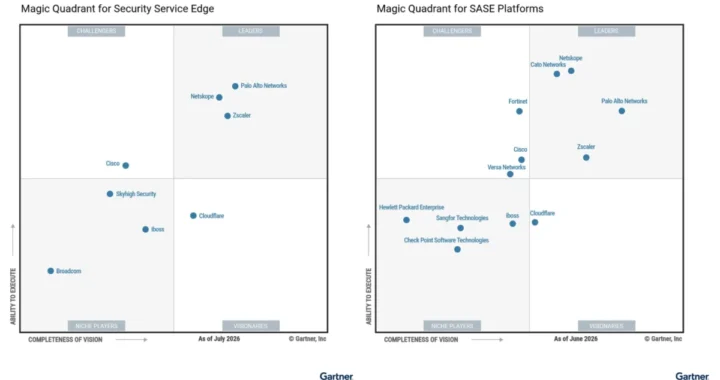
Palo Alto Networks, recognized by Gartner as a "company to beat" in AI Security Platforms, is uniquely positioned to guide enterprises through this transformative period. The Prisma AIRS AI Gateway is built on an architecture that has been rigorously tested and proven in the most demanding enterprise environments, designed to adapt to the ever-evolving landscape of AI workloads.
Organizations are encouraged to learn more about Prisma AIRS AI Gateway and register for an upcoming webinar to witness its capabilities in action. As developers continue to embrace AI agents and the agentic enterprise becomes the norm, Palo Alto Networks is committed to helping businesses build this future securely, together.
"Your developers have already adopted their agents. The agentic enterprise is a reality," [Quote from Palo Alto Networks executive, potentially a concluding statement]. "As the recently named ‘company to beat’ in AI Security Platforms by Gartner, Palo Alto Networks is uniquely positioned to help you. Let’s build it securely, together."
For more information on Prisma AIRS AI Gateway, visit [Link to AI Gateway product page] or contact [Link to contact page].