






In the rapidly evolving landscape of Architecture, Engineering, and Construction (AEC), artificial intelligence is often discussed in terms of futuristic capabilities—generative design, autonomous robotics, and predictive site safety. However, according to Brett Poulos, national director of preconstruction and estimating at Burns & McDonnell, the industry’s most significant hurdle is not the capability of the AI itself, but the chaotic state of the data that fuels it.
For contractors eager to harness the power of machine learning and large language models, the path to innovation begins with a tedious but vital prerequisite: the organization, standardization, and governance of project information. As the AEC industry stands on the precipice of a $228 billion annual value opportunity by 2030, the divide between industry leaders and those left behind will be defined by one primary metric: the ability to structure data.
The Data Dilemma: Bridging the Information Silo
The construction industry is historically fragmented. From the initial conceptual design documents to procurement records, cost estimates, project schedules, and operational data, information is rarely centralized. Instead, it exists in disconnected silos, often locked away in proprietary software or legacy systems that do not communicate with one another.
"Until that data is structured, it’s very hard to manage and it’s very hard to leverage and ingest into an AI ecosystem or into your decision-making capabilities," Poulos explains.
For AI to provide meaningful insights, it requires a "clean" and standardized input. When data is inconsistent—such as cost estimates recorded in varying formats across different departments—the AI’s output becomes unreliable. Poulos emphasizes that the industry’s primary function is decision-making. The quality of a project’s delivery is a direct reflection of the quality of the decisions made, which in turn depends on the data provided to project stakeholders. By standardizing the "backbone" of project information, firms can shift from reactive troubleshooting to proactive optimization.
A Chronology of Integration: From Reality Capture to AI-Driven Execution
The journey toward AI maturity is not an overnight transformation; it is an iterative process of digital integration. Burns & McDonnell has been testing these methodologies in high-stakes environments, such as a recent multimillion-dollar expansion of an animal health monoclonal antibody manufacturing facility.
The project presented a massive challenge: the facility needed to undergo a complex renovation while remaining in near-continuous operation. Furthermore, the work was subject to rigorous oversight by both the USDA and European Union regulatory bodies, leaving zero margin for error.
The project timeline followed a strategic integration path:
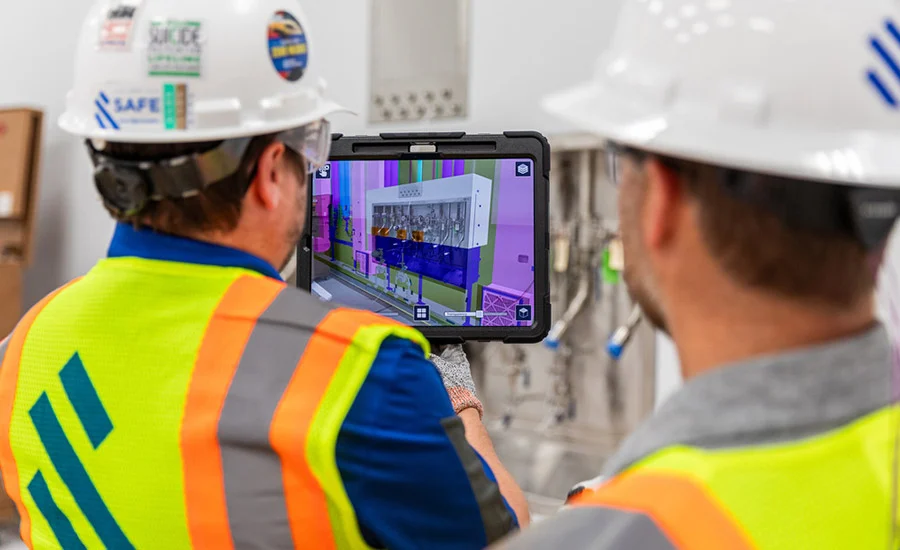
- Reality Capture: Utilizing laser scanning and drones to create a digital twin of the existing facility.
- Model Synchronization: Continuously updating the BIM (Building Information Modeling) environment to reflect real-time field conditions.
- AI-Enabled Tracking: Applying AI algorithms to monitor construction progress against the baseline schedule.
- Predictive Intervention: Identifying potential clashes or supply chain delays before they impacted the field, allowing the team to optimize shutdown periods and eliminate costly rework.
This case study serves as a proof-of-concept for how integrated data, when fed into AI systems, can navigate extreme regulatory and operational constraints while delivering value that traditional construction management methods might miss.
The Macro View: McKinsey’s Projections and Industry Shifts
A recent report from the McKinsey Global Institute highlights that AI will not necessarily act as an "extinction event" for traditional AEC firms. Instead, it will be the great separator. The report notes that early adopters are already realizing significant gains in productivity and design feasibility. However, these advantages are rapidly becoming "table stakes"—the minimum requirements to compete in a modern marketplace.
The projected $228 billion in annual value by 2030 underscores the massive scale of the AI-driven transformation. McKinsey suggests that the true industry leaders will be those that effectively use AI to control three critical pillars:
- Client Relationships: Leveraging AI to provide transparency and data-backed guidance.
- Workflows: Streamlining repetitive tasks to focus human capital on complex problem-solving.
- Underlying Data: Turning institutional history into a competitive asset.
Implications for the Future: A "Hot Take" on M&A
One of the most provocative implications of the data-centric AI revolution is the potential for a wave of mergers and acquisitions (M&A). Poulos posits that as companies realize the limitations of owning only a single "slice" of the project lifecycle, they may seek strategic partnerships or acquisitions to capture the full breadth of data.
"I think companies are going to realize that if they only own individual silos of those data processes—like if you only own the construction data and another firm owns the design data—it’s harder to leverage the data and make decisions earlier in the process," Poulos says.
If an engineering firm merges with a construction contractor, the resulting combined entity gains access to a continuous stream of data that flows from initial design intent to final field execution. This allows the AI to "learn" from the entire project history, providing better feedback loops that lower costs and increase efficiency. While independent firms will retain their place in the market—particularly for projects that do not require high-level integrated delivery—those chasing complex, high-budget, or time-sensitive projects will likely be forced to adopt more integrated, data-sharing collaborative models.
Building the Foundation: Governance, Training, and Pilots
Before any firm commits to a full-scale AI rollout, Poulos suggests a rigorous three-step preparation process:
1. Establishing Semantic Architecture and Governance
Data is only as good as the policies that govern it. Firms must define the "semantic architecture" of their data—essentially, a common language that AI can understand. Furthermore, strict governance is required to protect proprietary information. Companies must establish clear policies regarding what data is "AI-safe," what is sensitive, and how it is secured. Without these guardrails, firms risk exposing sensitive intellectual property or creating inconsistent, potentially dangerous AI practices.
2. Comprehensive Employee Training
Technology is only as effective as the people who use it. Burns & McDonnell has invested heavily in firm-wide training, ensuring that staff members across all levels understand not only how to operate AI tools but also the ethical and practical implications of their use. Training creates a culture of "AI literacy," which is essential for successful adoption.
3. The Pilot Project Model
"You wouldn’t want to roll it out enterprise-wide without having test cases for successful pilots," Poulos cautions. Pilot programs serve as the proving ground. They allow firms to calculate the Return on Investment (ROI) and verify technical feasibility in a controlled environment. By starting with smaller, manageable projects, firms can refine their AI implementation strategies before committing to an organization-wide deployment.
Conclusion: The Path Forward
The allure of AI in construction is undeniable, promising a future of faster, cheaper, and more accurate project delivery. Yet, as the industry navigates this transition, the message from leaders like Brett Poulos is clear: do not look for the "magic button" software solution. Instead, look to your own files.
The firms that will dominate the next decade are not necessarily the ones with the most advanced algorithms, but the ones with the most organized data. By prioritizing structural integrity in information management, establishing robust governance, and fostering a culture of continuous learning, contractors can transform from information-heavy, insight-poor entities into the high-performing, AI-driven leaders of tomorrow. The data is already there; the challenge lies in giving it a voice.