





Executive Summary: The Dawn of Physical Intelligence
For years, the presence of robotics at global technology summits like Mobile World Congress (MWC) was often dismissed as a high-tech gimmick. From mechanical quadrupeds performing backflips to robotic baristas serving lattes, these spectacles served primarily to showcase the "potential" of low-latency connectivity. However, the discourse at MWC Shanghai 2026 has signaled a definitive end to the era of novelty.
The convergence of Generative AI and robotics—often referred to as "Embodied AI"—is driving a fundamental re-engineering of global telecommunications infrastructure. As AI leaps from the digital confines of smartphones and laptops into the physical world, the industry is coalescing around 5G-Advanced (5G-A) as the essential foundational layer. This transition represents more than a speed upgrade; it is a paradigm shift toward symmetrical, deterministic, and token-aware networks capable of supporting a projected 15 billion AI terminals by 2035.
Chronology: From Novelty to Necessity (2020–2026)
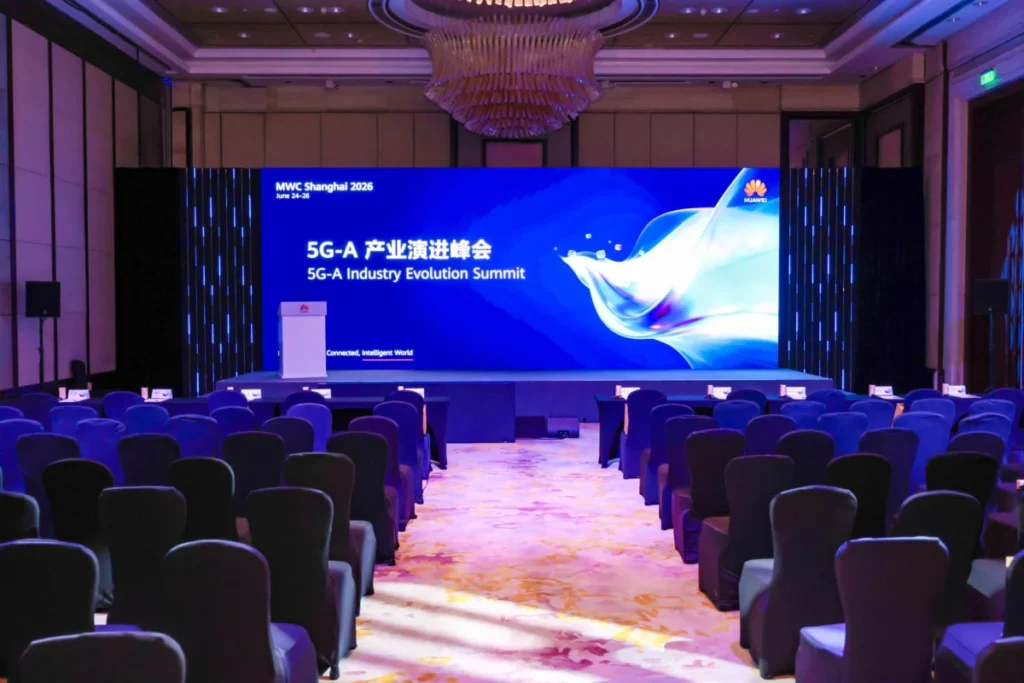
The journey to the 5G-A Industry Evolution Summit in Shanghai has been defined by a rapid acceleration in how machines interact with their environment.
- 2020–2022: The Connectivity Foundation. Early 5G deployments focused almost exclusively on the consumer experience—specifically, the insatiable demand for downlink speed driven by 4K video streaming and social media. Robots during this period were largely tethered to local Wi-Fi or operated on limited, pre-programmed scripts.
- 2023–2024: The AI Inflection Point. The explosion of Large Language Models (LLMs) and Multi-modal AI began to change the requirements for "intelligence." Honor’s humanoid robot, ‘Lightning,’ made headlines by breaking the world record for a half-marathon, demonstrating that mobility and AI could coexist at high performance. Simultaneously, robot dogs began patrolling the FIFA World Cup, moving from controlled lab environments to complex, high-stakes public security roles.
- 2025: The 5G-A Transition. As 3GPP Release 18 (the first set of 5G-Advanced standards) reached maturity, operators began moving beyond "best-effort" connectivity. The focus shifted to "uplink" capacity as robots started generating as much data as they consumed.
- 2026: The Shanghai Consensus. At the MWC Shanghai 2026 Summit, the narrative shifted toward "Physical AI." The industry recognized that to scale autonomous humanoid robotics and real-time digital twins, the network must act as an external "robotic brain," offloading the massive computational and energy burdens that local hardware cannot sustain.
Supporting Data: The Technical Architecture of Embodied AI
To understand the scale of this transformation, one must look at the specific technical benchmarks established by industry leaders at the 5G-A Summit.
The Uplink Revolution
Historically, mobile networks have been asymmetrical, favoring the "downlink" (data coming to the user). Embodied AI flips this requirement. A single humanoid robot equipped with multiple high-definition cameras, LiDAR, and environmental sensors requires a massive "uplink" to send situational data to the cloud for real-time processing.
- The 20Mbps Baseline: Global operators have reached a consensus that a 20Mbps consistent uplink is the absolute minimum requirement to sustain real-time AI modeling and situational awareness.
- The Scaling Challenge: While current 5G can support a handful of robots at a single site, the goal for 2026 and beyond is "High-Density Intelligence." China Unicom Beijing noted that while two cameras per robot are manageable, moving to eight cameras across a fleet of 100 robots operating simultaneously creates a data bottleneck that traditional 5G cannot clear.
- Huawei’s GigaUplink: To meet this demand, Huawei introduced its "GigaUplink" solution, which utilizes multi-antenna technology and advanced algorithms to provide a five-fold increase in uplink capacity compared to standard 5G.
Latency and Determinism
In the world of physical AI, "best-effort" delivery is no longer acceptable. If a consumer’s video buffers for a second, it is an inconvenience; if an autonomous industrial vehicle’s command buffers for a second, it is a safety catastrophe.
- Human-Like Response: For robots to interact safely in human environments, they require a total system latency of approximately 650ms—the threshold for human-like reaction speeds.
- Deterministic Performance: 5G-A provides "guaranteed" performance levels, moving away from the fluctuating speeds of consumer-grade internet to a "deterministic" model where latency and throughput are locked in, regardless of network congestion.
The Energy Equation
A critical barrier to the adoption of humanoid robots is battery life. Running high-end GPUs (Graphics Processing Units) directly on a mobile robot consumes massive amounts of power, often limiting operation to just one or two hours.
- Remote Brain Logic: Data presented by TD Tech suggests that operating a robot via a "remote brain" in the cloud consumes 20 times less energy than running those same autonomous computations on the device itself. This makes the 5G-A network the "umbilical cord" that makes commercial robotics viable.
Official Responses: Insights from Industry Leaders
The 5G-A Industry Evolution Summit featured a rare alignment between hardware manufacturers, network providers, and research analysts.
Chen Qi, President of AI Product Line at TD Tech:
"We shouldn’t be putting the pressure of compute on terminals. High energy consumption and short battery life are the primary limiting factors for the robotics industry. By moving the ‘robotic brain’ to the cloud and relying on 5G-A networks, we solve the hardware weight and power problem in one stroke."
Yang Lifan, Deputy General Manager of China Unicom Beijing:
"Our challenge is scale. We need to highly optimize our 5G-A networks for conditions where hundreds of robots are operating simultaneously. This requires a much greater focus on uplink than we have ever had in the history of telecommunications."
Eric Yang, President of Huawei Carrier Business:
"Big bandwidth, uplink expansion, and user experience guarantees are the three pillars. These will be the key network features that enable the mobile AI era. We are moving from a world of ‘connecting people’ to a world of ‘orchestrating intelligence’."
David Li, President of Huawei’s TDD Product Line:
Li emphasized the importance of the Upper 6GHz (U6G) spectrum. "U6G is the second-best spectrum for widespread 5G-A deployment after C-band. We must actively promote U6G to ensure we have the capacity to support the coming surge in AI terminals."
Tim Hatt, Head of Research and Consulting at GSMA Intelligence:
Addressing the spectrum debate between the mobile and Wi-Fi industries, Hatt noted: "Mobile is much more likely to be capacity-constrained than Wi-Fi in the AI era. Securing the 6GHz band for 5G-A is essential for maintaining global connectivity standards."
Implications: Escaping the "Volume Trap" through the Token Economy
Perhaps the most significant revelation from the Summit was the proposed shift in how telecommunications companies will generate revenue in the future. For the last decade, the industry has been stuck in a "volume trap"—where data traffic grows exponentially, but Average Revenue Per User (ARPU) remains stagnant because customers pay for "gigabytes," not the value of the information.
The Shift to Token Monetization
In the world of AI, the unit of value is the "token" (the basic unit of text or data processed by an AI model). Huawei and other partners are advocating for a "Byte-plus-Token" strategy.
- Network-as-a-Service (NaaS): Operators will move away from simple data plans toward tier-based, deterministic service guarantees. An industrial client might pay for a "Gold Tier" connection that guarantees 20Mbps uplink and 600ms latency for their robot fleet.
- Billing for Compute, Not Just Transport: By re-engineering networks around token transmission, telcos can bundle and resell AI capacity. They become orchestrators of compute power, not just "dumb pipes" for data.
- Reducing Friction: This model allows AI developers to build applications without worrying about the underlying hardware constraints, as the network handles the heavy lifting of routing and securing AI tokens.
The Path to 2035
As the industry looks toward the next decade, the implications are clear. The 5G-A network is the prerequisite for the "Intelligent World 2035." By securing additional spectrum in the U6G band and refarming legacy 2G and 4G bands into ultra-wideband 5G-A channels, operators can provide the "ubiquitous smooth service" required for a world where humans and robots coexist.
Conclusion: The Indispensable Backbone
The consensus from MWC Shanghai 2026 is that the mobile industry is at a crossroads. The transition to 5G-Advanced is not merely a technical necessity to support more data; it is a strategic pivot to capture the value of the physical AI revolution. By acting as the unified orchestrators of spectrum, uplink capacity, and computational power, telecommunications companies can finally step out of the volume trap and secure their place as the indispensable nervous system of the 21st-century global economy.