






The modern enterprise is no longer defined solely by its office space or human capital; it is defined by its digital nervous system. As we advance toward 2030, the convergence of artificial intelligence (AI), the Internet of Things (IoT), and high-density wireless environments is creating an unprecedented demand for infrastructure that is simultaneously robust, flexible, and efficient. At the heart of this evolution lies a transformative synergy: the marriage of IEEE 802.3bt Power over Ethernet (PoE++) and multi-gigabit data throughput.
For decades, Power over Ethernet was a niche solution, powering simple VoIP handsets and basic security cameras. Today, it has evolved into the backbone of smart buildings, capable of delivering up to 100W of power and 10Gbps of data over a single copper cable. This paradigm shift is not merely a convenience—it is a strategic imperative for organizations aiming to remain competitive in a data-saturated landscape.
Main Facts: The New Standard of Power and Speed
The integration of PoE++ (IEEE 802.3bt) and multi-gigabit Ethernet (2.5G/5G/10G BASE-T) marks a definitive departure from legacy networking. By utilizing all four pairs of a standard twisted-pair Ethernet cable, PoE++ provides the wattage necessary to power advanced endpoints—such as AI-driven surveillance arrays, high-performance Wi-Fi 7 access points, and automated smart lighting—without the need for dedicated electrical outlets.
The core facts defining this technological leap are:
- Power Density: The 802.3bt standard allows for up to 100W at the source, effectively quadrupling the power capacity compared to earlier PoE+ iterations.
- Data Throughput: Multi-gigabit speeds ensure that bandwidth-heavy applications, such as real-time 4K/8K video analytics and high-density IoT sensor clusters, operate without latency.
- Single-Cable Efficiency: By consolidating power and data, organizations reduce cabling complexity, installation labor costs, and raw material consumption (copper), contributing to significant sustainability goals.
- Market Trajectory: The PoE chipset market is projected to expand from roughly $2.78 billion in 2025 to $5.57 billion by 2031, reflecting a compound annual growth rate (CAGR) of approximately 20%.
A Chronological Evolution: From Voice to Vision
To understand the magnitude of the current transition, one must look at the progression of IEEE standards. The journey of PoE is a testament to engineering adaptability.

- 1990s – The Genesis: Ethernet was strictly a data medium. Electrical power was delivered via separate, bulky AC infrastructure, creating significant limitations for device placement.
- 2003 – IEEE 802.3af (PoE): The first standardized attempt to provide power over data lines. Delivering roughly 15W, it was the catalyst for the widespread adoption of VoIP telephony.
- 2009 – IEEE 802.3at (PoE+): As devices like pan-tilt-zoom (PTZ) cameras and mid-range wireless access points emerged, the standard was pushed to 30W to meet increased power requirements.
- 2018 – IEEE 802.3bt (PoE++): A breakthrough moment. By utilizing all four pairs of copper cabling, the standard reached 60W (Type 3) and 100W (Type 4), opening the door for smart lighting, thin-client computing, and high-performance IoT sensors.
- 2024–2030 – The Era of Integration: Current efforts are focused on pairing this high-wattage delivery with 10Gbps speeds and AI-driven power management, ensuring the network is not just a carrier, but an intelligent resource manager.
Supporting Data: Why Speed and Power are Non-Negotiable
The urgency for these upgrades is driven by the sheer scale of the "connected device explosion." Industry projections estimate that by 2030, billions of IoT endpoints will be active in the enterprise sector. The Ethernet Alliance has noted that the shift from 1G to multi-gigabit speeds at the access layer is no longer a luxury; it is the baseline for functional campus networking.
Recent market analysis indicates that 33% of organizations currently planning infrastructure expansions are specifically requesting deployments exceeding 51W. This demand is fueled by:
- AI-Driven Edge Computing: AI cameras require significant local processing power and high-speed data transmission for real-time edge analytics.
- Wi-Fi 7 Transition: The latest wireless standard demands higher throughput and consistent power to manage complex modulation and multi-link operations.
- Smart Building Automation: Integration of environmental sensors, occupancy detectors, and automated HVAC/lighting controls requires a highly reliable, low-voltage power distribution network.
Official Responses and Industry Perspectives
Industry leaders and standardization bodies, including the Ethernet Alliance, emphasize that interoperability remains the biggest hurdle to universal adoption. The Ethernet Alliance PoE Gen 2 Certification Program has been established to solve this, ensuring that switches and powered devices from different vendors adhere to the strict requirements of IEEE 802.3bt.
"The goal," notes a spokesperson for Versa Technology, "is to ensure that infrastructure is ‘future-ready.’ Organizations that attempt to build modern smart environments on legacy power infrastructure face severe bottlenecks, particularly regarding heat dissipation and signal integrity."
Experts argue that as we push higher current through copper, the quality of the cabling (Cat6A and beyond) becomes a critical factor. Cat6A, with its superior shielding and heat dissipation characteristics, is now widely considered the minimum requirement for 10G and 100W PoE deployments.

Implications: The Future of the Intelligent Enterprise
The move toward PoE++ and multi-gigabit infrastructure has profound implications for how buildings are designed and operated.
Intelligent Power Management
Future networks will utilize AI and machine learning to manage power allocation. By utilizing priority queuing and predictive budgeting, PoE switches can prevent brownouts during peak usage. This level of granular control ensures that critical systems—such as security and life-safety sensors—always receive the power they need, even if the total power budget is temporarily strained.
The Sustainability Mandate
Beyond speed, the environmental argument for PoE is compelling. By reducing the number of AC electrical circuits required in a building, organizations significantly lower their copper footprint. Furthermore, DC power distribution is inherently more efficient than traditional AC-to-DC conversion at every single endpoint, leading to a measurable reduction in energy waste across the enterprise.
Extending the Edge
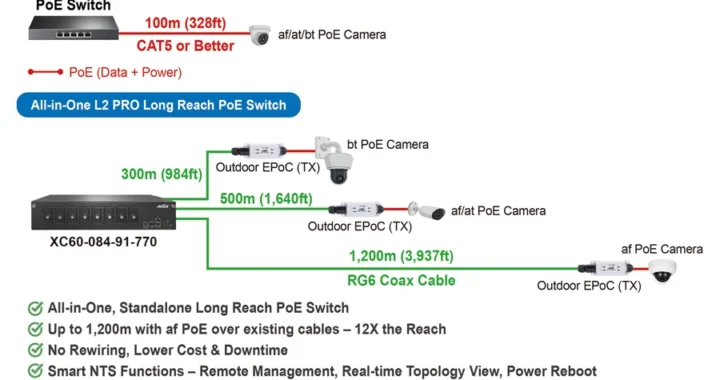
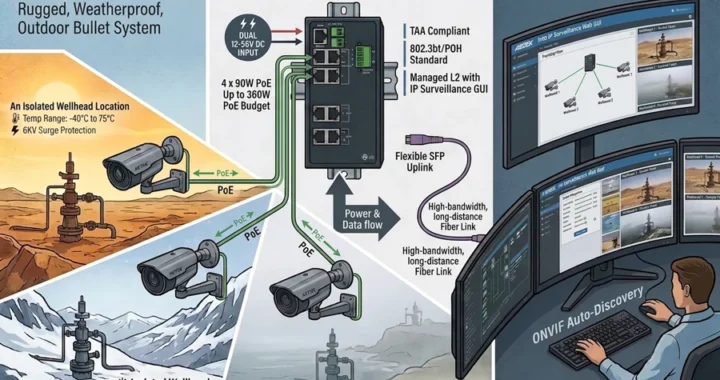
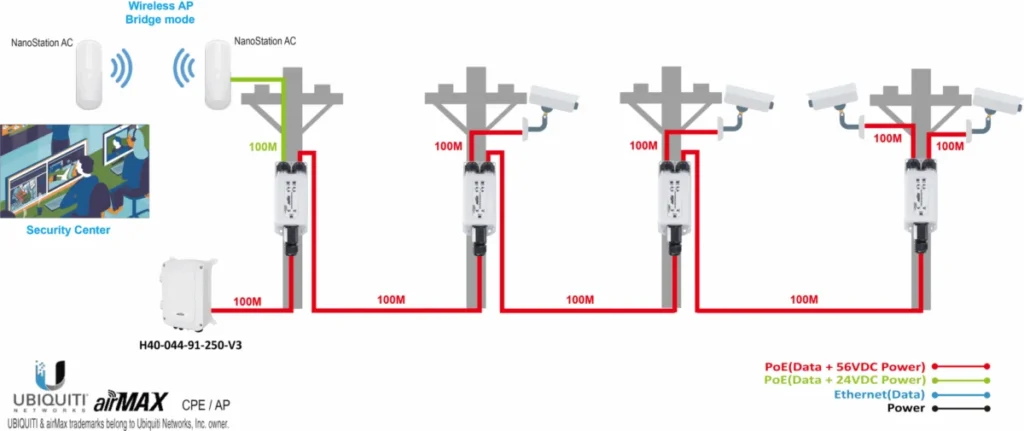
The challenge of the 100-meter limit for Ethernet cabling is being overcome through innovative "extended reach" solutions. Using fiber-to-copper media converters or daisy-chained PoE extenders, businesses can now push high-speed, high-power connectivity to the very fringes of a campus, including outdoor parking lots, remote warehouses, and distributed industrial sites.
Strategic Planning: Avoiding "Rip-and-Replace"
The primary risk for any organization today is "technical debt." A common mistake is investing in high-speed data switches without ensuring that the underlying power delivery is sufficient for future device generations. Proper design today—focusing on Cat6A cabling and PoE++ compliant switches—prevents the massive financial burden of a full network overhaul in three to five years.

Conclusion: Preparing for the Next Decade
The evolution of PoE is a mirror of the evolution of the enterprise itself. What began as a simple method to keep a phone running has transformed into the primary mechanism for powering the intelligent, automated, and hyper-connected environments of the 2030s.
As organizations navigate this transition, the focus must be on sustainability, interoperability, and scalability. By auditing current network capabilities and consulting with Ethernet Alliance-certified partners, businesses can ensure that their infrastructure is not merely keeping pace, but leading the charge. The era of high-power, multi-gigabit connectivity is here; those who invest in this foundation today will hold the competitive advantage of tomorrow. For those ready to modernize, the path forward is clear: integrate, automate, and accelerate.