




In the high-stakes world of modern data center management, uptime is the ultimate currency. Every element of the facility—from the cooling systems and power distribution units (PDUs) to the smallest electrical conduit fittings—is scrutinized for its potential to compromise the “white space.” As facilities scale to support the demands of artificial intelligence, machine learning, and cloud-native workloads, the focus has shifted toward a microscopic, yet potentially catastrophic, challenge: zinc whiskers.
While electrical fittings may seem like a tertiary concern, the material science behind these components is becoming a critical component of risk mitigation strategies. For operators, the choice between zinc-plated steel and zinc die cast is no longer just a procurement decision; it is a fundamental engineering choice that directly impacts the long-term integrity of sensitive IT infrastructure.
The Physics of Failure: Understanding Zinc Whiskers
Zinc whiskers are microscopic, hair-like filaments that grow from surfaces electroplated with zinc. These structures, which can reach lengths of several millimeters, are electrically conductive. When these filaments break off due to vibration, thermal expansion, or physical disturbance, they can become airborne, circulating through a facility’s cooling system or settling onto sensitive circuit boards.
Because they are conductive, zinc whiskers can bridge electrical contacts on printed circuit boards, leading to short circuits, intermittent equipment failures, and, in severe cases, complete system outages. For a data center operator, the most insidious aspect of these whiskers is that the root cause of a failure is often nearly impossible to diagnose post-mortem, as the tiny filaments are easily disturbed or destroyed during troubleshooting.
The Chronology of Concern
The industry’s awareness of this issue has evolved in phases:
- Early 2000s: The phenomenon gains attention as older mainframe-era facilities undergo renovations. During the demolition of raised floor systems, dust containing zinc whiskers becomes airborne, leading to widespread equipment failures in adjacent, operational server rooms.
- 2010s: As high-density computing becomes the norm, industry standards (such as the ASHRAE guidelines for gaseous and particulate contamination) begin to emphasize the importance of air quality, inadvertently putting the spotlight on zinc-plated materials.
- 2024 and Beyond: Data center operators are now implementing "whisker-free" procurement policies. Material selection has moved from a maintenance concern to a design-phase requirement for new construction.
Material Comparison: Steel vs. Die Cast
To address the risk, Bridgeport, a leader in electrical fitting technology, has advocated for a deeper understanding of the metallurgical differences between common fitting materials.
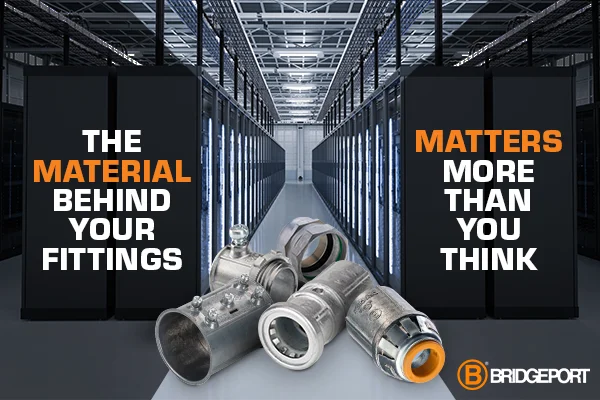
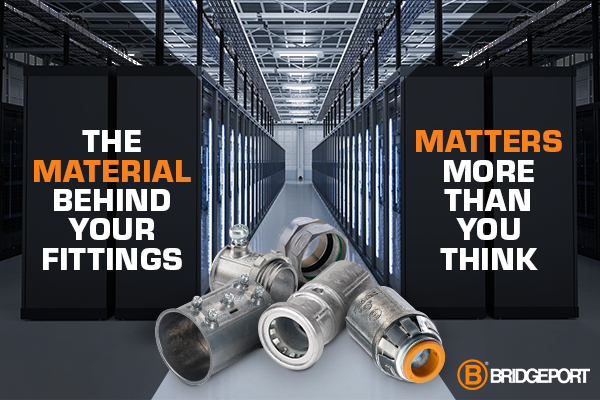
Zinc-Plated Steel: The Legacy Risk
Zinc-plated steel fittings are ubiquitous in the electrical industry. They consist of a steel substrate coated with a thin layer of electroplated zinc to prevent corrosion. The manufacturing process involves significant internal stress within the zinc coating. Over time, particularly in the climate-controlled, stable environments of a data center, this internal stress is relieved through the growth of these metallic whiskers.
Despite the use of passivation and organic topcoats designed to inhibit growth, these methods are not permanent. They provide a barrier that may degrade over the product’s 20- to 30-year service life, leaving the facility vulnerable to potential contamination.
Zinc Die Cast: The Engineered Solution
In contrast, zinc die cast fittings are manufactured by injecting molten zinc alloy into a mold to create a homogeneous, solid component. Because these parts are not electroplated, they do not possess the residual stress associated with the plating process. Consequently, they are fundamentally immune to the formation of zinc whiskers.
For facility designers, this provides a "set it and forget it" solution. By opting for zinc die cast, operators remove a potential failure vector from their infrastructure before the first rack is even installed.
Supporting Data and Performance Metrics
The industry standard for electrical fittings, UL 514B, serves as the baseline for safety and performance. Bridgeport’s zinc alloy fittings meet or exceed these requirements, proving that operators do not have to sacrifice mechanical strength or electrical continuity to gain the benefits of whisker-free technology.
Comparative Advantages:
- Corrosion Resistance: Zinc alloys exhibit superior inherent resistance to oxidation compared to steel, which relies entirely on its thin protective plating.
- Dimensional Consistency: Die-cast components are manufactured with high-precision molds, ensuring a consistent fit that simplifies installation and reduces labor costs.
- Thermal Stability: These fittings maintain their structural integrity across the temperature fluctuations common in hot-aisle/cold-aisle containment systems.
The Institutional Perspective: Official Responses
Leading data center design firms and hyperscale operators are increasingly incorporating material-specific clauses into their master specifications.
"The cost of a single hour of downtime far exceeds the incremental difference between commodity fittings and engineered solutions," says one industry consultant specializing in facility hardening. "When we draft specifications for mission-critical facilities, we are moving away from electroplated materials in areas that have airflow. It’s about building in resilience at the molecular level."
Bridgeport’s mission aligns with this shift. By focusing on quality and innovation, the company is positioning itself as a partner in the data center ecosystem, providing the hardware that ensures the "always-on" promise of the digital economy remains unbroken.
Implications for the Future of Infrastructure
The move toward zinc die cast is part of a broader trend: the "Hardening of the Data Center." As facilities become more dense and rely on more complex hardware, the margin for error shrinks.
Economic Implications
While zinc die cast fittings may carry a different price point than traditional zinc-plated steel, the "Total Cost of Ownership" (TCO) analysis favors the former. If an operator avoids a single emergency site visit or a premature equipment replacement caused by a short circuit, the return on investment for using premium fittings is realized instantly.
Sustainability and Compliance
Modern data centers are under pressure to improve sustainability. Components that last longer and require less maintenance contribute to a smaller environmental footprint. Furthermore, as international standards for data center cleanliness (such as ISO 14644-1) become more stringent, using materials that are inherently non-shedding and non-contaminating becomes a key component of regulatory compliance.
Conclusion: Making the Right Choice
The transition from zinc-plated steel to zinc die cast is a microcosm of the evolution of data center engineering. As the industry matures, it moves away from general-purpose industrial components toward specialized, high-reliability materials designed for the unique challenges of the IT environment.
For engineers, contractors, and facility owners, the message is clear: material selection matters. By prioritizing zinc die cast components, stakeholders can mitigate the risks associated with microscopic contaminants, ensure longer equipment lifecycles, and support the reliability that the modern world demands.
In the final analysis, protecting the data center starts at the very beginning of the supply chain. By choosing solutions engineered for the rigors of mission-critical facilities, operators are not just buying fittings—they are investing in the stability of their entire digital infrastructure.
Learn more about how Bridgeport is engineering the future of data center infrastructure.