





In the modern era of cloud-native architecture, engineering teams have achieved a remarkable milestone: the ability to detect almost any anomaly, anywhere, at any time. Observability platforms have matured to the point where they can ingest telemetry from Kubernetes clusters, microservices, cloud infrastructure, databases, and sprawling network dependencies with millisecond precision. Yet, despite this technological leap, a persistent "human" bottleneck remains.
When a critical incident strikes, the systems meant to help often become a source of sensory overload. Responders are frequently bombarded by a deluge of individual alerts—each technically accurate, each signaling a symptom, but collectively masking the root cause. This "alert fatigue" forces engineers to spend their most valuable minutes manually stitching together a narrative before they can even begin to address the problem.
New Relic is now aiming to solve this systemic inefficiency with the launch of Compound Alerts. By shifting the paradigm from individual signal monitoring to intelligent, issue-based consolidation, New Relic is fundamentally changing how engineering organizations navigate the chaos of a production outage.
The Core Challenge: The Cost of Fragmented Visibility
The Signal-to-Noise Paradox
For years, the industry focused on improving the quality of alerts. Engineering teams moved away from static thresholds toward dynamic baselines, seeking to reduce the sheer volume of false positives. While this reduced "noise," it did not solve the problem of "symptom fragmentation."
In a distributed system, a single failure—such as a database connection pool exhaustion—can trigger a cascade of alerts across the stack: latency spikes in the frontend, error rate increases in the application layer, and pod restarts in the Kubernetes orchestrator.
The Human Toll of "Context Assembly"
When these alerts arrive as individual notifications, the operational cost is twofold. First, there is the cognitive load: the responder must mentally map how a Kubernetes pod restart correlates with a database timeout. Second, there is the operational inefficiency: without an automated "big picture," multiple responders may independently investigate different symptoms of the same problem, leading to duplicated effort, conflicting remediation attempts, and extended downtime.
In essence, teams have been forced to act as human middleware, manually correlating data that the observability platform already possesses.
The Solution: Introducing New Relic Compound Alerts
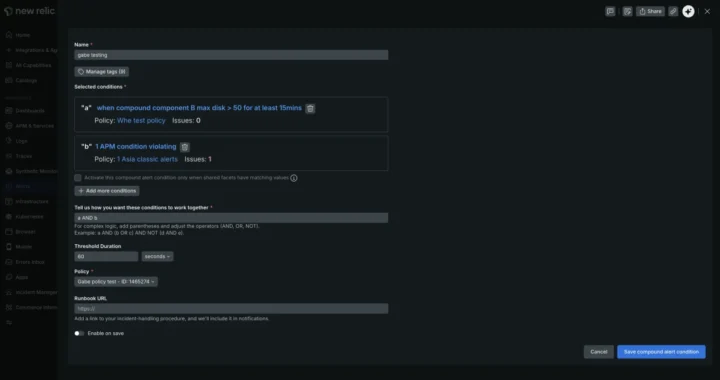
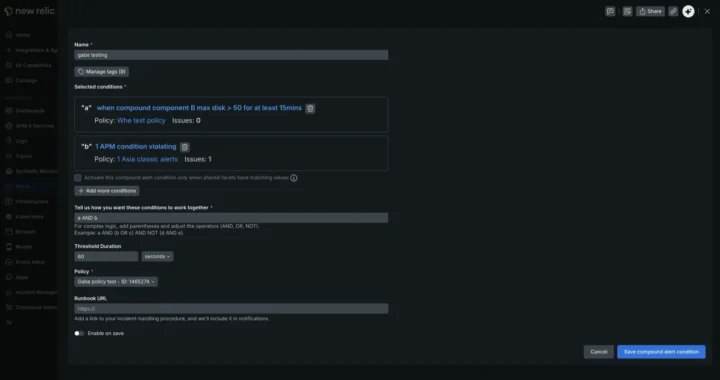
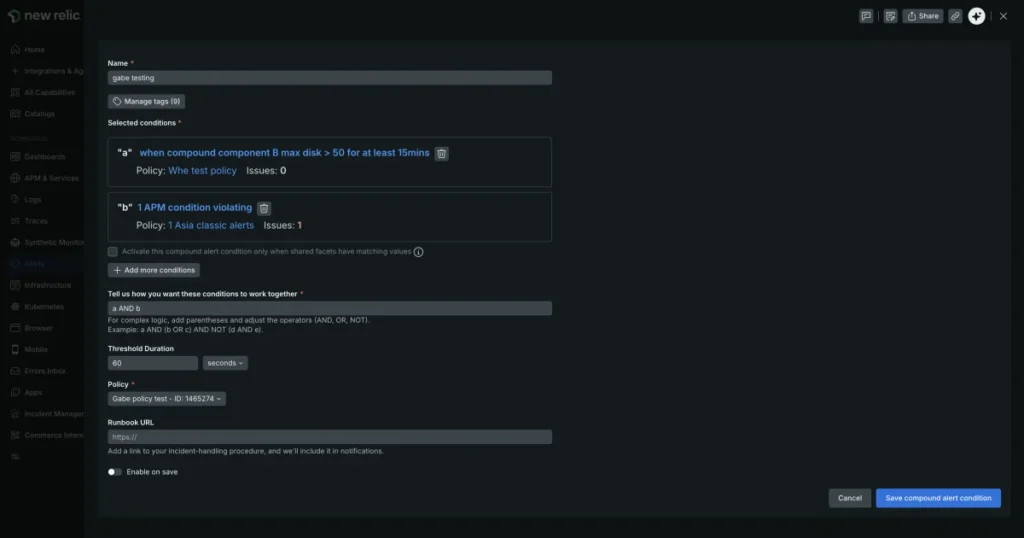
New Relic Compound Alerts is designed to automate the synthesis of operational data. By intelligently grouping related alert conditions into a single "actionable issue," the platform transforms a fragmented list of symptoms into a cohesive narrative.
How It Works: From Symptoms to Solutions
Compound Alerts functions as an intelligent layer atop New Relic’s existing monitoring infrastructure. When multiple alert conditions trigger within a related operational scope, the system identifies the commonalities—such as shared services, related tags, or overlapping timeframes—and consolidates them.
Instead of receiving ten different notifications, a responder receives one high-level alert that clearly delineates:
- The Scope: Which services and infrastructure components are involved.
- The Narrative: A consolidated view of the timeline and the correlation between disparate signals.
- The Action: A single entry point for investigation, preventing the "siloed" response pattern that plagues many organizations.
Chronology: Building the Foundation of Intelligent Operations
The release of Compound Alerts is not an isolated product update; it is a strategic progression in New Relic’s broader "Intelligent Observability" roadmap.
Phase 1: Telemetry and Detection (The "What")
The foundation, naturally, is data. New Relic’s platform has long excelled at capturing high-fidelity telemetry, providing the raw material for observation.
Phase 2: Smart Alerts (The "Quality")
Before one can group alerts, one must ensure they are meaningful. New Relic introduced Smart Alerts to refine the signals themselves. By leveraging dynamic thresholds and machine learning, Smart Alerts ensures that the conditions triggering an incident are legitimate, reducing the noise floor.
Phase 3: Compound Alerts (The "Context")
With high-quality signals in place, the focus shifted to relationships. Compound Alerts represents the current state-of-the-art for New Relic, providing the connective tissue that allows engineers to move from "something is wrong" to "this specific set of services is failing together."
Phase 4: Future Horizons (The "Autonomous")
Looking ahead, New Relic has outlined a path toward Autonomous Operations. Following the integration of Compound Alerts, the company is layering in Ground Truth (which adds deep, trusted operational context) and Autopilot (which assists in active investigation). This progression suggests a future where AI does not just tell you what is happening, but proposes—and eventually executes—the remediations required to fix it.
Implications: Productivity and Operational Efficiency
The introduction of Compound Alerts carries significant implications for the bottom line of engineering organizations.
1. Reducing Mean Time to Resolution (MTTR)
The most immediate benefit is a reduction in MTTR. By eliminating the time wasted on "assembling the puzzle," teams can move directly to the remediation phase. In high-stakes environments, saving five or ten minutes of investigation time can equate to thousands of dollars in preserved revenue and customer trust.
2. Lowering Cognitive Load
Burnout is a genuine threat to engineering health. The constant pressure of "alert triage" is mentally draining. By simplifying the interface and providing a clearer operational starting point, New Relic is indirectly improving the quality of life for on-call engineers.
3. Improving Cross-Team Collaboration
When a single issue is presented as a unified incident, it acts as a "source of truth" for the entire organization. When a backend engineer, a DevOps specialist, and a SRE look at the same dashboard, they are seeing the same problem. This reduces friction in communication and accelerates the collaborative debugging process.
Expert Perspectives and Strategic Context
Industry analysts have long argued that the next frontier of observability is not more data, but more meaning.
"The market is moving past the era of ‘monitoring everything,’" notes a lead developer within the New Relic ecosystem. "We are entering the era of ‘understanding everything.’ Compound Alerts is the bridge that allows us to do that at scale. When you are managing 500+ microservices, you cannot afford to manually link alerts. The machine must do the linking for you."
The strategic shift here is a recognition that cloud-native environments are simply too complex for human-only correlation. By embedding this logic into the platform, New Relic is aligning itself with the growing trend of AIOps—the application of artificial intelligence to IT operations.
The Role of AI in the Modern Stack
As organizations adopt more complex architectures—including serverless, multi-cloud, and AI-driven applications—the number of potential failure points grows exponentially. Manual investigation is no longer a viable strategy for scaling. Compound Alerts acts as an essential pre-processor for AI-assisted operations; it cleans and structures data in a way that allows both human responders and AI agents to make better, faster decisions.
Conclusion: A Step Toward the Future of Ops
The ultimate goal of any engineering team is to deliver reliable, high-performance digital experiences. However, the complexity of modern infrastructure often stands in the way of that goal.
New Relic’s Compound Alerts addresses this by removing the friction that exists between detection and resolution. By treating operational issues as holistic events rather than isolated symptoms, the platform empowers engineers to focus on what truly matters: fixing the problem, improving the system, and driving innovation.
As the industry continues to evolve, the distinction between "monitoring" and "understanding" will become the primary differentiator for high-performing teams. With this latest development, New Relic has positioned itself as a leader in the movement toward a more intelligent, more efficient, and ultimately more autonomous operational future. For organizations struggling under the weight of their own complexity, Compound Alerts is not just a feature—it is a necessary evolution of the incident response lifecycle.