





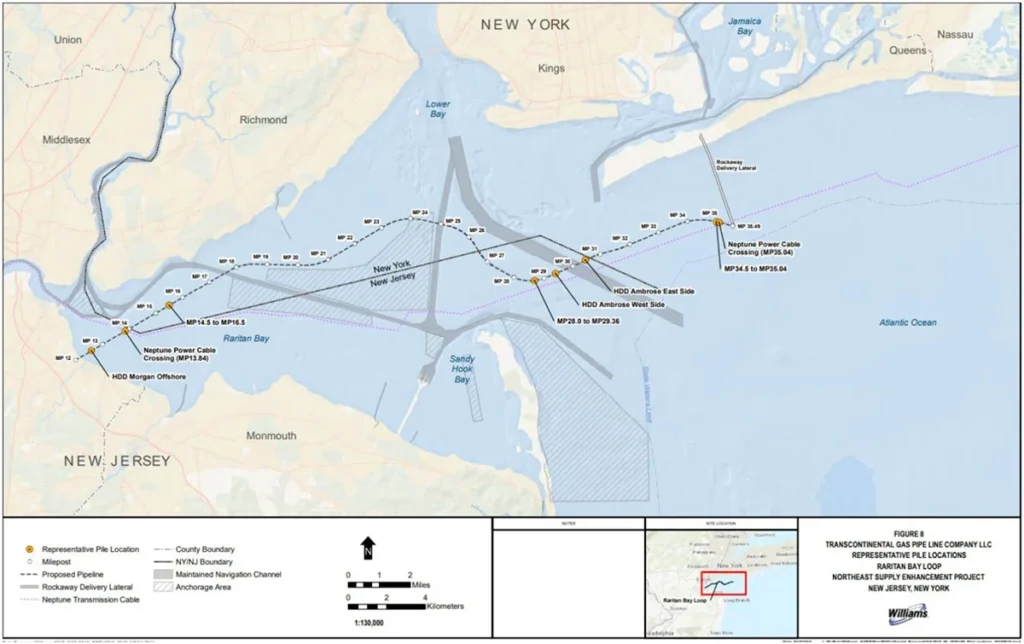
In a significant legal blow to the development of the Northeast Supply Enhancement (NESE) natural gas pipeline, a federal appeals court has vacated New Jersey’s water-quality certification for the $1-billion-plus project. The decision, handed down on September 8 by the U.S. Court of Appeals in Philadelphia, marks a pivotal moment in the multi-year battle over the infrastructure project, which is designed to bolster natural gas capacity for New York City and Long Island.
The court’s ruling centers on the New Jersey Department of Environmental Protection’s (NJDEP) failure to adequately resolve critical monitoring requirements and explain how the proposed dredging operations in Raritan Bay would adhere to state environmental standards. By sending the Clean Water Act Section 401 certification back to the NJDEP for further proceedings, the court has effectively stalled a major component of the regulatory framework that Williams Cos. needs to break ground.
A Tale of Two States: Contrasting Legal Outcomes
The judicial scrutiny of the NESE project has produced a divergent legal landscape across the two states involved in the pipeline’s path. Less than three weeks prior to the New Jersey ruling, a separate federal appeals court upheld New York’s water-quality certification for the same project.
The distinction between the two rulings lies in the specificity of regulatory safeguards. In the New York case, the court noted that the state’s approval was contingent upon a rigorous review of compliance plans before construction begins. New York’s certification further mandates the presence of an independent, third-party monitor with the explicit authority to halt construction, alongside strict pollutant limits. The Philadelphia court highlighted these safeguards in its recent opinion, suggesting that New Jersey’s regulatory oversight lacked the same level of granular, enforceable protection.
Project Scope and Strategic Importance
The NESE project is a massive infrastructure undertaking aimed at expanding the Transcontinental Gas Pipe Line (Transco) system, a subsidiary of Williams. The project involves the construction of approximately 37 miles of new pipeline, along with the development of a new compressor station in Somerset County, New Jersey, and the 3.4-mile "Madison Loop" in Middlesex County.
The centerpiece of the environmental controversy, however, is the six-mile offshore segment that would traverse Raritan Bay. Installing this underwater segment requires extensive dredging of the seabed to create a trench for the pipe, which would then be backfilled. Once operational, the project is designed to deliver an additional 400,000 dekatherms of natural gas per day to National Grid customers in New York City and Long Island. Williams continues to target a fourth-quarter 2027 in-service date, though the recent court intervention places that timeline under considerable pressure.
Chronology of Regulatory and Legal Friction
The path to the current impasse has been paved with years of regulatory filings and litigation.

- November 2025: Both the New Jersey Department of Environmental Protection and their counterparts in New York issued their respective Section 401 certifications, signaling a major regulatory milestone for the project.
- Late 2025: A coalition of environmental advocacy groups, citing concerns over the impact on marine life and the potential mobilization of legacy contaminants, filed suit against the NJDEP’s approval.
- August 2026: A federal appeals court upheld the New York certification, citing robust third-party oversight and proactive compliance measures.
- September 8, 2026: The U.S. Court of Appeals in Philadelphia vacated the New Jersey certification, characterizing the state’s approval process as "arbitrary and capricious."
Technical Concerns: The Contaminant Crisis
A significant portion of the court’s criticism focused on the potential environmental impact of dredging in Raritan Bay. The court noted that the sediment along the proposed route is far from pristine; it contains a cocktail of hazardous substances, including arsenic, manganese, mercury, polychlorinated biphenyls (PCBs), and 4,4′-DDE—a persistent breakdown product of the pesticide DDT.
The court’s scrutiny revealed glaring gaps in the NJDEP’s risk assessment. Specifically, the court noted that Transco’s own modeling indicated that concentrations of 4,4′-DDE at two sampling locations—500 feet from the dredging site—would exceed New Jersey’s human-health criteria. At one location, the modeled concentration was more than 13 times the state’s safety threshold.
While the NJDEP attempted to mitigate these risks by reducing the dredging rate and requiring work to occur during slack tide, the court found these measures insufficient, noting that the agency failed to recalculate the DDE concentrations under these new operating conditions. Furthermore, the court criticized the agency for requiring monitoring of water turbidity (cloudiness) while failing to mandate monitoring for the actual toxic contaminants, stating that the agency provided no evidence that turbidity monitoring would serve as a proxy for the presence of mercury or PCBs.
Official Responses and Stakeholder Positions
In the wake of the ruling, stakeholders have responded with a mix of defiance, caution, and celebration.
Williams Cos. remains committed to the project. Cherice Corley, a spokesperson for the company, stated in an email to Reuters that Williams is actively working with state regulators to address the court’s findings. Despite the legal hurdle, the company maintains a optimistic outlook regarding the schedule. "At this time, we do not expect the decision to adversely affect project construction or the anticipated in-service timeline," Corley said.
Environmental Advocates have hailed the ruling as a significant victory for local communities. Ben Dziobek, executive director of the Climate Revolution Action Network, emphasized that the decision protects the integrity of the Raritan Bay ecosystem. "No fossil fuel company—no matter how much political support it has in Washington—gets to cut corners on the protections our communities are entitled to," Dziobek stated.
The State Regulatory Body now faces the task of revisiting the certification. The court’s order does not force the NJDEP to reject the project outright. Instead, the agency has been granted the opportunity to supplement its technical findings, mandate additional submissions from the developer, or revise the certification to include more stringent monitoring requirements.

Implications for Future Infrastructure
The ruling carries broader implications for the development of energy infrastructure in the United States. It underscores a growing judicial trend that demands rigorous, transparent, and evidence-based regulatory analysis when granting environmental certifications.
The court’s decision specifically highlighted the inadequacy of "unfinished" plans. The NJDEP had allowed the project to move forward with the requirement that Transco submit water-quality monitoring and adaptive-management plans at a later date, without making agency approval of those plans a prerequisite to the actual dredging. The court’s rejection of this "approval-after-the-fact" approach sets a precedent that may force state agencies to demand finalized, concrete mitigation strategies before issuing permits.
Furthermore, the court’s discovery that the NJDEP erroneously attributed scientific claims regarding surf-clam recovery to marine experts—when the claims actually originated from the developer—highlights the danger of regulatory agencies appearing to act as a conduit for industry data without independent verification. This perceived lack of objective analysis was a major factor in the court’s decision to label the certification "arbitrary and capricious."
Looking Ahead: What Happens Next?
As the case returns to the NJDEP, the project’s future rests on the department’s ability to reconcile its regulatory requirements with the court’s demands for scientific rigor. The department may choose to:
- Request New Modeling: Require Transco to re-model contaminant dispersion under the revised dredging conditions.
- Impose Direct Monitoring: Require real-time monitoring of specific toxic chemicals rather than relying on turbidity as a surrogate.
- Strengthen Oversight: Incorporate the "third-party monitor" model used in New York to ensure that construction halts automatically if environmental thresholds are breached.
For Williams, the path forward requires navigating both the technical requirements of the NJDEP and the ongoing public pressure from environmental groups. The NESE project remains a litmus test for how natural gas infrastructure can be balanced against the increasing sensitivity to local water quality and the legacy of industrial pollution in waterways like Raritan Bay. Whether the project can maintain its 2027 completion target will depend entirely on how swiftly and thoroughly the state can address the legal gaps identified by the federal court.