





By [Your Name/ENR Staff]
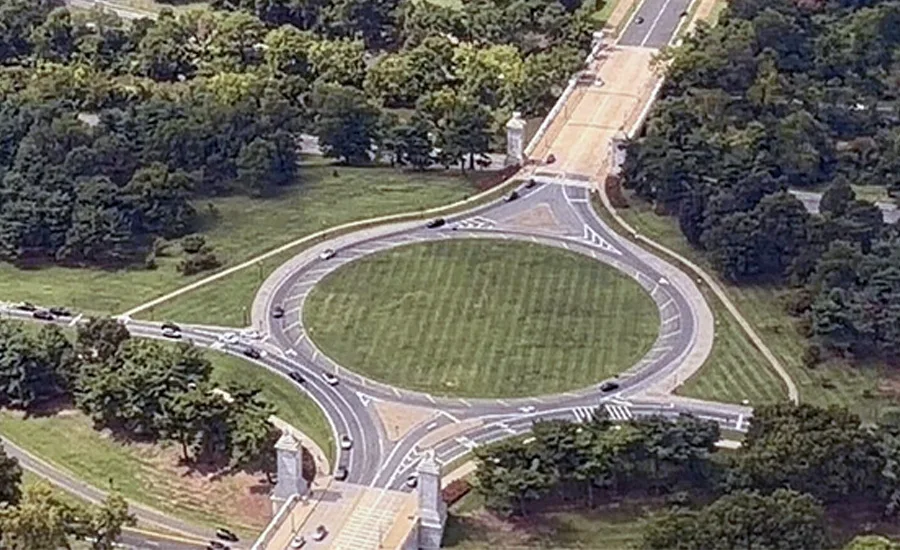
A federal judge has granted a narrow pathway for the National Park Service (NPS) to proceed with critical archaeological testing at Memorial Circle—the controversial site earmarked for President Donald Trump’s proposed 250-ft Triumphal Arch. While the ruling provides the green light for initial site investigation, it simultaneously reinforces stringent federal oversight, establishing a high bar for any future construction activities.
The decision, handed down on September 4 by U.S. District Judge Tanya Chutkan, serves as a pivotal development in an ongoing legal battle concerning the intersection of federal monument development, historic preservation, and judicial oversight.
The Judicial Ruling: Balancing Preservation and Development
Judge Chutkan’s order arrived in response to an emergency motion for a temporary restraining order (TRO) filed by plaintiffs challenging the project. The plaintiffs argued that a recent social media declaration by Interior Secretary Doug Burgum signaled an imminent commencement of unauthorized construction activity.
Under the terms of the ruling, the government is permitted to conduct "Phase 1B" archaeological testing. However, the court mandated that any activity beyond these specific investigative parameters requires a 48-hour advance notification. More significantly, the judge reaffirmed that any movement toward actual construction or demolition—prior to final NPS authorization and without a minimum of 14 days’ notice—would constitute a direct violation of existing court orders established in April.
This ruling effectively freezes the development phase while allowing the necessary due diligence required by the National Historic Preservation Act (NHPA) to proceed.
Chronology of the Dispute
The escalation of the project at Memorial Circle has been marked by a series of legal and administrative maneuvers.

- April 2026: An initial consent order is established between the government and plaintiffs, mandating that the National Park Service must provide public disclosure and a 14-day lead time before commencing any construction-related site work.
- September 3, 2026: Interior Secretary Doug Burgum posts to the social media platform X, stating that the Department of the Interior is preparing to begin "excavation work necessary for the Great Triumphal Arch" within a two-week timeframe.
- September 4, 2026: Plaintiffs file an emergency motion for a Temporary Restraining Order, alleging the Secretary’s post suggests a breach of the April consent order.
- September 4, 2026 (Afternoon): Judge Tanya Chutkan issues an order clarifying that while archaeological testing may proceed, the government is strictly bound by the notice requirements regarding construction.
- Late September 2026 (Projected): Commencement of Phase 1B testing, pending the issuance of a formal special-use permit by the NPS.
- October 31, 2026 (Projected): Completion of site restoration following the test pit excavation.
Technical Scope: The Phase 1B Archaeological Protocol
To satisfy federal historic preservation requirements, the NPS has outlined a rigorous testing plan. According to a sworn declaration by NPS Regional Director Jennifer Nersesian, the upcoming work is strictly limited to data collection.
Crews are slated to excavate four mechanical test pits, each measuring approximately 8 ft by 16 ft. The locations are strategically chosen to correspond with the structural footprint of the proposed arch:
- One pit at each of the two proposed arch footings.
- One pit within the boundary of the planned plaza.
- One pit at the site of the proposed sanitary sewer pump station.
A professional archaeologist will remain on-site throughout the process to monitor excavation efforts. The primary objective is to survey the soil stratigraphy—the layering of soil deposits—to identify any archaeological features or cultural materials buried beneath the modern fill. Depending on the depth of the excavation and the stability of the soil, the crews may be required to implement shoring or other protective engineering systems to ensure worker safety and prevent wall collapse.
Supporting Data and Environmental Context
Memorial Circle represents a complex engineering and archaeological landscape. Situated between Arlington National Cemetery and the Arlington Memorial Bridge, the area is not virgin soil. Historical analysis indicates that the site sits atop roughly 10 to 14 feet of 20th-century fill.
The National Park Service has officially classified this area as "moderately to highly sensitive" for the presence of intact precolonial or historic resources. This sensitivity is a primary driver behind the current Phase 1B testing. While this testing is relatively low-impact—expected to conclude in seven to 14 days—it is distinctly separate from the heavy construction phase.
The primary construction, should it proceed, is projected to span two to three months of intensive excavation. This would involve preparing the broader project footprint to support foundations reaching depths of approximately 75 feet to reach bedrock, a significant structural undertaking given the site’s proximity to the Potomac River and the historic nature of the surrounding monuments.
Official Responses and Stakeholder Positions
The Justice Department, representing the government, maintained in court that Secretary Burgum’s comments on social media were misinterpreted. Attorneys argued that the Secretary was referring to the previously disclosed archaeological testing, not the commencement of the arch’s foundation work.

The plaintiffs, represented in Michael Lemmon, et al., v. Donald J. Trump, et al., continue to emphasize that the project’s scale poses an irreversible threat to the historic integrity of the National Mall corridor. By seeking the TRO, the plaintiffs aimed to ensure that the "slippery slope" of site preparation does not inadvertently lead to permanent construction before all regulatory hurdles are cleared.
The National Park Service remains in a precarious position, tasked with facilitating a project of immense political significance while simultaneously upholding the rigorous preservation standards mandated by federal law. The issuance of the special-use permit, which is still pending, will be the final administrative step required before the first shovel hits the dirt.
Implications for Future Development
The ongoing litigation surrounding the Triumphal Arch highlights a growing trend in American infrastructure: the increasing difficulty of reconciling grand-scale, politically charged monument projects with the modern framework of environmental and historical oversight.
Regulatory Precedents
If the project proceeds to full-scale construction, it will likely serve as a case study for future megaprojects on federal land. The requirement for deep-foundation engineering in a historically protected zone ensures that every phase of the project will face intense scrutiny from preservationist groups and the judiciary.
Engineering Challenges
From an engineering perspective, the transition from Phase 1B testing to the main construction phase will be a significant logistical challenge. The need to excavate 75 feet to bedrock requires specialized equipment that could cause vibrations or drainage issues affecting the nearby Arlington Memorial Bridge and the cemetery’s perimeter. The success of the current testing is not just about historical findings; it is about gathering geotechnical data to ensure the long-term stability of the structure.
The Role of Transparency
The court’s insistence on 14-day notice periods and strict adherence to administrative procedures signals a lack of judicial patience for informal project communications. As the 2026 calendar year moves toward its conclusion, the focus will remain on whether the NPS can provide the transparency required to satisfy the court, or if further legal intervention will continue to delay the project.
For now, the focus at Memorial Circle remains on the soil. The four pits, while small in the context of a 250-ft arch, carry the weight of a national debate regarding what should be built on public land and who holds the authority to decide. As the September 21 start date for testing approaches, all eyes will be on the site, the archaeologists, and the clock.