



In the high-stakes world of luxury vertical development, success is often measured by what the public never sees. Beneath the future 62-story St. Regis Residences in Sunny Isles Beach, Florida, lies an engineering triumph that serves as the literal bedrock for one of the most ambitious oceanfront projects in the region.
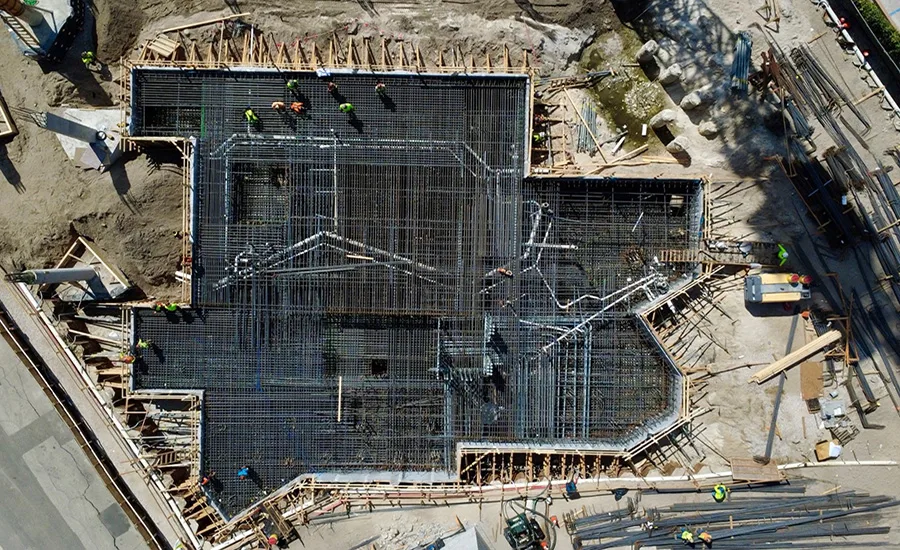
Beginning in the early evening of July 24 and continuing through the following day, Miami-based Coastal Construction Co. executed a massive, continuous 8,400-cubic-yard mat foundation pour. This operation was not merely a construction milestone; it was a high-precision logistical ballet that cleared the path for the tower’s vertical ascent, transforming a challenging coastal site into a stable foundation capable of supporting a skyscraper.
The Engineering Challenge: Conquering the Coast
Building a 62-story tower on a narrow barrier island presents a unique set of geotechnical obstacles, most notably the high water table that sits just feet below the surface. To anchor such a massive structure, the project team had to excavate approximately 40 feet below grade through volatile, groundwater-laden coastal soils.
Long before the concrete trucks arrived, the project team engaged in extensive ground-stabilization efforts. Specialty geotechnical contractor Keller North America was brought in to engineer a solution that would allow for a dry, stable excavation. Using massive 6-foot augers, crews mixed native soils with cement at depths of 60 to 70 feet, creating a “low-permeability plug.” This underground barrier effectively sealed the excavation site from the surrounding ocean-influenced groundwater.
Once the plug was established, the team installed approximately 470 auger-cast piles. Recognizing the importance of long-term structural integrity, the project owners opted to install over 100 additional piles beyond the initial design requirements. This proactive measure significantly reduced predicted foundation settlement from 18 inches to a negligible 2 inches, providing a rigid base for the impending mat foundation.

Chronology of a Mega-Pour
The 16-hour continuous placement was the culmination of six weeks of intensive planning. However, the project’s timeline was dictated by external factors, including the local influx of visitors during the FIFA soccer World Cup. Municipal officials requested that the massive logistical undertaking be delayed until the tournament concluded to minimize the impact on local traffic.
Once the date was finalized, the project team worked backward. The final weeks were defined by weekly—and eventually daily—coordination meetings involving Coastal Construction, concrete subcontractor Baker Construction, ready-mix supplier CEMEX, and various municipal agencies.
The Logistics of Precision
Managing the influx of 1,000 ready-mix trucks required a level of coordination akin to air traffic control at one of the nation’s busiest airports. To ensure the pour remained continuous—a vital requirement to prevent cold joints that could compromise the slab’s structural integrity—the team utilized four dedicated CEMEX batch plants.
These plants fed six boom pumps strategically positioned around the perimeter of the excavation. Every truck route, delivery time, and staging area was mapped out in advance. Because the site fronts Collins Avenue (A1A), the main thoroughfare of the barrier island, the project required meticulous maintenance-of-traffic plans, including police details and scheduled lane closures, to prevent the construction from paralyzing local transit.
Supporting Data and Technical Execution
The success of the pour relied on a "rhythm" that allowed for zero downtime. As John DiPaula, general superintendent for the St. Regis project, noted, "There are a lot of moving parts in order to make this a success."

- Concrete Volume: 8,400 cubic yards.
- Duration: Less than 16 hours.
- Logistics: 1,000 truck deliveries.
- Infrastructure: 6 boom pumps; 4 dedicated batch plants.
- Risk Mitigation: On-site mechanics, backup pumps, and towing equipment were stationed at the ready to address any potential mechanical failures instantly.
Quality control was integrated into the flow of traffic. Every tenth truck was diverted from the pump line for rigorous testing, ensuring the concrete mix met strict slump and temperature specifications. If a truck failed to meet these standards, it was immediately removed from the rotation, and a replacement was already waiting in the queue.
Official Responses and Human Coordination
For the team at Coastal Construction, the human element was as critical as the concrete itself. Nekita Whyte, a senior project manager at the firm, emphasized the importance of cross-departmental partnerships. "You have the structural side, the MEP side, your superintendents, your office team, but also the trade partners… CEMEX… and all the suppliers of the material," Whyte explained.
The intensity of the operation was highlighted by the team’s reaction to the final permit approvals. "Passing those [inspections] and being cleared to place concrete is always one where you hold your breath," Whyte admitted.
Even weather proved to be a formidable adversary. Throughout the 16-hour window, the site team monitored lightning activity within an 8-mile radius. Despite the pressure, the operation proceeded with only a single minor interruption when a weather alert was issued with just 40 cubic yards of concrete left to pour—a testament to the meticulous planning that allowed the work to continue despite environmental variables.
Post-Placement: The Curing Phase
The completion of the pour was only the beginning of a new set of responsibilities. As the massive concrete mass began to set, it generated significant heat, which could lead to internal cracking if not properly managed.

The mat foundation immediately entered a 14-day wet-curing regimen. The team utilized insulating blankets and a constant hosing system to regulate the temperature, ensuring that the chemical reaction within the concrete remained stable. This phase is critical to achieving the design strength required to support the weight of a 62-story luxury tower.
Implications for the Industry
The success at the St. Regis site follows a broader trend of complex, high-stakes foundation work in South Florida. During the same period, Coastal Construction successfully executed a separate 1,800-cubic-yard pour for the Shorecrest condominium project in West Palm Beach.
These operations underscore a shift in the construction industry toward hyper-managed logistics. As urban sites become tighter and the demands of high-rise luxury towers increase, the ability to execute continuous, uninterrupted foundation pours is becoming a competitive necessity.
The St. Regis project serves as a masterclass in risk management and stakeholder coordination. By treating the foundation as an "engineering event" rather than just a construction task, the team was able to navigate the constraints of a narrow, water-logged site, the demands of municipal traffic, and the unpredictable nature of coastal weather.
"Right people in the right roles and proper planning," DiPaula concluded. "We’ve done this dozens of times. We didn’t miss anything on this one." With the foundation now solid and curing, the future of the St. Regis Residences is literally set in stone, marking the transition from a complex geotechnical exercise to the vertical realization of a luxury landmark.