




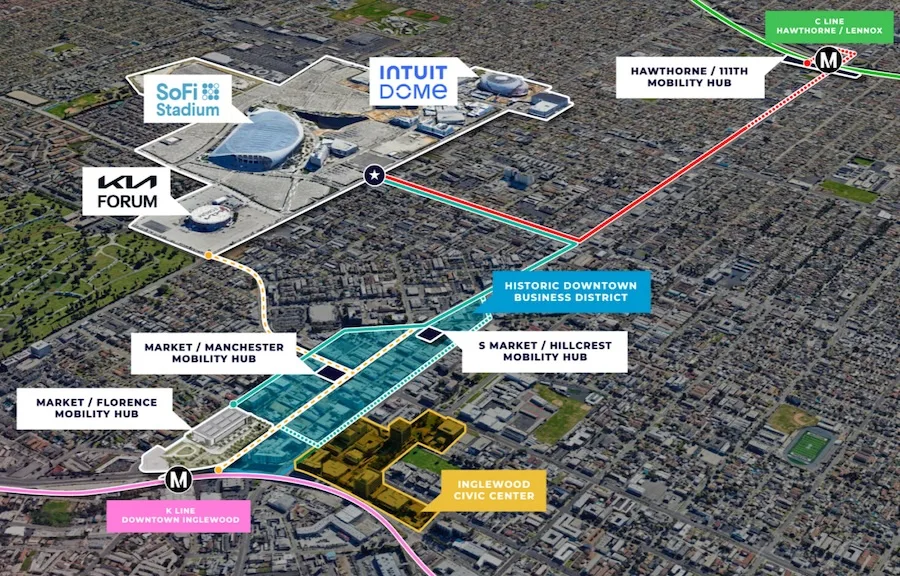
As the world prepares to descend upon Los Angeles for the 2028 Olympic and Paralympic Games, the City of Inglewood is aggressively transforming itself from a quiet residential suburb into a global sports and entertainment powerhouse. With the recent City Council approval of a $261-million public-private partnership (P3), Inglewood is launching the Inglewood Transit Connector (ITC) Phase 1—an ambitious infrastructure overhaul designed to untangle the chronic gridlock surrounding the SoFi Stadium and Intuit Dome corridor.
By shifting the risks of construction and maintenance onto a private consortium, the city is betting that it can secure a seamless transit future without jeopardizing its municipal budget.
The Strategic Mandate: Managing the Mega-Event Surge
Inglewood has undergone a metamorphosis over the last decade. Once a city of 100,000 residents, it has become the focal point of Southern California’s entertainment landscape. Between the 70,000-seat SoFi Stadium, the cutting-edge Intuit Dome, and the historic Kia Forum, the city hosts more than 60 major annual events. These gatherings draw hundreds of thousands of visitors, creating a logistical bottleneck that has long plagued local traffic flow and frustrated residents.
The ITC Phase 1 project is the city’s proactive solution. By implementing dedicated shuttle lanes, smart traffic management, and significant pedestrian infrastructure, Inglewood aims to ensure that when the 2028 Olympics arrive, the city’s arteries remain open and functional.
Chronology of Development: From Concept to Construction
The project is moving at a rapid clip, with groundbreaking scheduled for November. The timeline is dictated by the hard deadline of the 2028 Games, necessitating a highly efficient delivery model.
- Competitive Procurement: Through a rigorous competitive bidding process, the city selected the Elevate Inglewood Development Company (EIDC) as the Best Value Proposer. The consortium brings together global expertise, led by Plenary Americas as the developer, Swinerton as the design-build contractor, and Walter P. Moore as the architect of record.
- November 2024: Official groundbreaking marks the commencement of site preparation and the start of the streetscape upgrade program.
- 2025–2027: Construction of the three major mobility hubs and the Florence Avenue pedestrian bridge.
- Pre-2028 Games: Completion of the intelligent transportation system integration, ensuring that signal synchronization and shuttle priority lanes are fully operational for the Olympic influx.
- 2028 and Beyond: Commencement of the 20-year operations and maintenance phase by EIDC, ensuring the longevity of the infrastructure.
Technical Innovation: The Steel-Centric Strategy
A cornerstone of the project is the pedestrian bridge spanning Florence Avenue, a critical link connecting the downtown core directly to the Metro K Line’s Downtown Inglewood Station. To meet the aggressive construction schedule while minimizing disruption to one of the city’s busiest corridors, the project team opted for steel over traditional cast-in-place concrete.
The Case for Steel
Eric Pagan, principal with Walter P. Moore, explains that steel was chosen for its distinct structural and logistical advantages. "Steel construction minimizes traffic disruption," Pagan notes. "The superstructure is erected in a single day with only limited and temporary lane closures—unlike cast-in-place concrete, which requires extensive on-site work and greater traffic impacts."
Beyond construction speed, steel provides:
- Superior Long-Span Capability: Thanks to its high strength-to-weight ratio, the bridge can span busy roadways with minimal structural depth and visual mass.
- Modular Prefabrication: Off-site fabrication allows for faster installation in constrained urban environments.
- Safety and Efficiency: The rapid erection of the structure creates a safe, walkable surface for workers much earlier in the construction cycle, reducing exposure to traffic.
Future-Proofing the Corridor
A hallmark of this design phase is the "preservation zone" strategy. Recognizing that an automated people mover (APM) system may be required in the future, the design-build team has intentionally avoided building permanent footings or utilities in the path of a future transit line.
"Rather than requiring significant redesign, the team strategically positioned key infrastructure, utilities, and structural elements to preserve future flexibility," says Jeff Goodermote, vice president and division manager of national parking structures with Swinerton. By planning for the APM footprint today, the city avoids the cost-prohibitive geometric re-engineering that often plagues transit projects built in stages.
Financial Architecture: The P3 Model
The $261-million project is structured as a Design-Build-Finance-Operate-Maintain (DBFOM) agreement. This model effectively shifts the burden of performance from the taxpayer to the private sector.
The Availability-Payment Model
Unlike traditional infrastructure projects that rely on user fees or fluctuating transit fares, the ITC project utilizes an "availability-payment" model. Under this arrangement:
- Fixed Payments: The city makes regular, fixed annual payments to EIDC.
- External Funding: These payments are drawn from secured state and regional transit grants, ensuring that Inglewood’s General Fund remains insulated from project costs.
- Performance Penalties: EIDC’s revenue is tethered to the quality of their work. If the facilities fall below strict technical performance baselines—such as cleanliness, safety, or repair standards—the city can issue direct financial deductions against the annual payout.
Councilmember Eloy Morales, Jr. emphasized the security this offers the city: "This agreement gives Inglewood one contract, one team, one fixed price and one deadline. The developer carries the cost and schedule risk, which protects Inglewood taxpayers."
Economic Implications and Community Impact
The ITC project is not merely an engineering feat; it is an economic catalyst. The city projects that the program will generate approximately $210 million in tax revenue and $1.5 billion in total economic output over the lifespan of construction and operations.
Workforce Development
The project includes a robust Project Labor Agreement (PLA) and a Community Workforce Agreement (CWA). These policies dictate:
- Local Hiring: 35% of all construction and long-term maintenance jobs must go to local Inglewood workers.
- Small Business Inclusion: A 20% goal for the participation of local small businesses in the supply chain and construction services.
These agreements aim to ensure that the massive capital investment directly improves the lives of Inglewood’s residents, providing high-quality jobs and opportunities for local firms.
The Broader Urban Vision
The integration of the Market & Florence Hub with the city’s "Destination Market Street" program signifies a holistic approach to urban planning. By combining transit-oriented retail, parking, a bus plaza, and a "kiss-and-ride" lot, the city is creating a vibrant, walkable core that serves both event attendees and daily commuters.
The installation of hardscaping, landscaping, and pedestrian-scale lighting is intended to improve the urban experience for all residents, not just those traveling to a game. By prioritizing wayfinding and street furniture, the city is effectively rebranding the downtown corridor as a hospitable, transit-accessible destination.
Conclusion: A Model for Future Mega-Events
The Inglewood Transit Connector serves as a blueprint for how mid-sized cities can host global mega-events without succumbing to the paralysis of extreme congestion. By leveraging private-sector efficiency, securing state-level transit grants, and planning for future technological expansions like the APM, Inglewood is demonstrating a level of foresight rarely seen in municipal infrastructure.
As the steel rises over Florence Avenue this November, it will symbolize more than just a bridge; it will represent a fundamental shift in how Inglewood manages its growth. The city is no longer just a host for games—it is a modern, connected hub, ready for the world.