





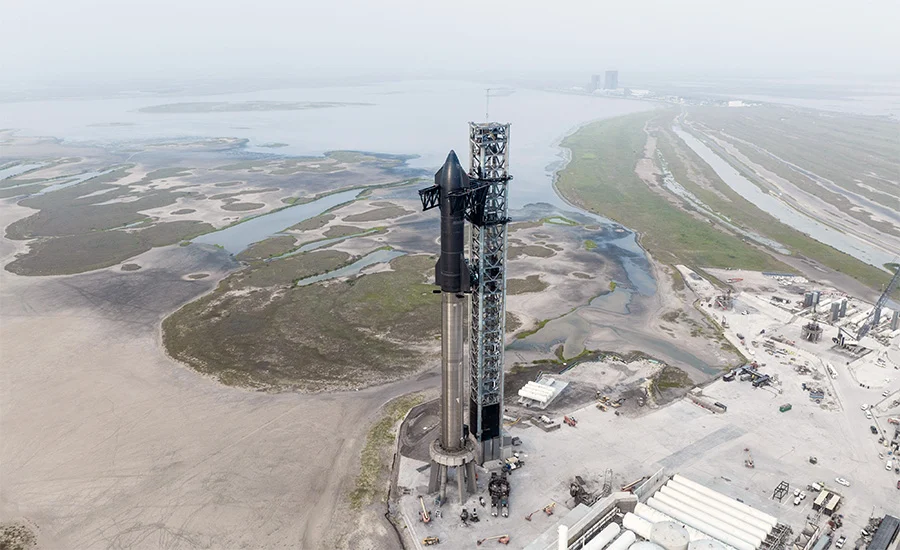
In a move that promises to reshape both the American aerospace landscape and the geography of the Gulf Coast, SpaceX announced on August 25 its ambitious proposal for "Starbase Louisiana." The project, a sprawling $100-billion spaceport, is slated to cover 125,000 acres in Vermilion Parish, Louisiana. Designed to serve as a high-frequency launch hub for the company’s Starship vehicle, the facility aims to normalize space travel by facilitating thousands of launches annually—a cadence currently unheard of in the industry.
This monumental undertaking represents the largest capital investment in Louisiana’s history, positioning the state as a critical node in the burgeoning commercial space economy. However, the sheer scale of the project, combined with its location in a fragile, erosion-prone coastal ecosystem, has sparked a complex debate pitting economic transformation against environmental preservation.
The Vision: A Science Fiction Reality
SpaceX founder and CEO Elon Musk described the project as a leap into a future that was once relegated to the pages of science fiction. "We’re preparing to build a spaceport that, until now, has only existed in science fiction," Musk stated. For Musk, the goal is clear: making space travel as routine as commercial aviation. To achieve this, SpaceX must move beyond the experimental phase and transition into a high-volume industrial operation, which requires a facility of unprecedented scope.
SpaceX President and COO Gwynne Shotwell detailed the engineering philosophy behind the campus, characterizing it as a "self-sustaining" ecosystem. The site is designed to include not only 10 specialized launch pads and vehicle-processing hangars but also an airport, deepwater shipping access, and residential infrastructure for the thousands of employees expected to staff the facility.
Chronology and Development Roadmap
While the announcement has set the industry abuzz, the timeline for execution is exceptionally aggressive.
- August 2026: SpaceX formally announces the Starbase Louisiana proposal, citing the state’s proximity to natural gas reserves and existing industrial infrastructure.
- Late 2027: Current projections from Louisiana Economic Development (LED) suggest the commencement of initial site construction.
- 2029: SpaceX is targeting the inaugural Starship launch from the Louisiana facility, leaving a narrow three-year window for planning, permitting, and infrastructure development.
The rapid timeline creates a significant challenge for regulatory bodies and project managers. The transition from marshland to a high-tech launch complex requires a synchronized effort across multiple sectors, including energy, transportation, and environmental engineering.
Supporting Data: The Logistics of Scale
The logistical requirements for Starship operations are staggering. The launch vehicle—a two-stage system consisting of the Super Heavy booster and the Starship upper stage—runs on a massive propellant load. Specifically, the Super Heavy booster relies on 33 Raptor engines fueled by approximately 8 million pounds of subcooled liquid methane and liquid oxygen.

If these fuels were to be transported to the site rather than produced on-site, the ground transportation burden would be catastrophic. Data from the Federal Aviation Administration (FAA) regarding SpaceX’s proposed operations at the Kennedy Space Center provides a sobering glimpse into these logistics: a single launch could necessitate the transit of 270 liquid-oxygen trucks, 80 liquid-nitrogen trucks, and 90 liquid-methane trucks.
To mitigate this, the Louisiana site will prioritize local propellant production facilities. By leveraging Louisiana’s abundant natural gas, SpaceX aims to create an integrated supply chain that reduces the need for off-site transportation, effectively bringing the fuel refinery to the rocket.
The Workforce and Infrastructure Challenge
The economic impact of the project is projected to be immense, though specific details remain opaque. LED estimates that the project will generate 34,516 construction jobs at its peak. While these figures represent a significant boon for the regional economy, officials have yet to release a detailed breakdown of how these jobs will be distributed or how the estimate was derived.
Furthermore, the project demands a massive upgrade to regional infrastructure:
- Energy: The campus will require significant power generation and transmission upgrades. SpaceX has committed to funding project-specific improvements to ensure that costs are not shifted onto existing ratepayers, though specific electrical load requirements remain undisclosed.
- Transportation: The Louisiana Department of Transportation and Development is currently evaluating Highway 82 and other surrounding routes. Bridges and roadways will need to be reinforced or expanded to handle the heavy-haul logistics required to move rocket components and construction materials.
- Employment: Beyond the transient construction force, the site is expected to support 3,000 permanent, high-skilled jobs over the next decade. Shotwell emphasized that the facility will require a diverse array of talent, ranging from aerospace engineers to specialized welders, technicians, and heavy-equipment operators.
Official Responses and Political Stakes
State leadership has embraced the project with open arms. Governor Jeff Landry has framed the spaceport as a unique opportunity to harmonize industrial development with coastal preservation. "This is the first time we can marry an economic development project that creates thousands of jobs with coastal restoration and hurricane protection," Landry remarked.
The state’s strategy involves integrating "marsh creation" into the construction phase. SpaceX has engaged with the Louisiana Coastal Protection and Restoration Authority to design a campus that includes hydrological improvements and shoreline stabilization, theoretically using the project to strengthen the state’s natural storm buffer.
Environmental and Regulatory Implications
Despite the official optimism, the project faces intense scrutiny from environmental advocacy groups. The Louisiana Wildlife Federation, the National Wildlife Federation, and the Pontchartrain Conservancy have formally expressed concerns to the FAA.

The primary point of contention is the site’s location near Pecan Island, a region defined by its delicate coastal marshlands. Environmental groups argue that the intensive development—involving massive dredging, filling, and the noise and light pollution associated with frequent rocket launches—poses an existential threat to one of the most productive wildlife habitats in the United States.
"Pecan Island is a celebrated piece of Louisiana’s ‘Sportsman’s Paradise,’ one of the most productive wildlife habitats in the U.S. and incredibly susceptible to coastal erosion and hurricanes," noted Rebecca Triche, Executive Director of the Louisiana Wildlife Federation.
The groups are particularly wary of potential efforts to fast-track or bypass standard environmental review processes. They contend that the 13 federal statutes governing such projects are critical for protecting the Gulf Coast’s biodiversity. SpaceX and state officials maintain that the development will undergo all necessary environmental, wetlands, and natural-resource reviews, and that the project site has been selected to avoid active restoration zones managed by the state.
Conclusion: A New Era for the Gulf
The Starbase Louisiana project represents a high-stakes gamble for all parties involved. For SpaceX, it is a necessary evolution to achieve the launch cadence required to make interplanetary travel a reality. For Louisiana, it is a transformative opportunity to diversify its economy away from traditional energy sectors and toward the future of aerospace.
However, the road ahead is fraught with uncertainty. With no major construction contracts yet awarded, no finalized design packages, and a complex environmental permitting process still in its infancy, the 2029 launch target remains a ambitious goal. Whether Starbase Louisiana becomes a beacon of modern innovation or a cautionary tale of over-development will depend on the ability of SpaceX and the state to manage the delicate intersection of high-octane engineering and the fragile, ever-changing Louisiana coastline. As the project moves from announcement to implementation, the eyes of the aerospace industry and environmental regulators alike will be firmly fixed on the marshes of Vermilion Parish.